1. Introduction
Reading fluency is a vital learning skill for students specialising in nursing, medicine, and modern technologies. If nurse students attain a high level of proficiency in fluent reading, they will make significant progress in their scientific understanding. In other words, Ermias and Taye
| [19] | Ermias Mulatu & Taye Regassa (2022). Teaching reading skills in EFL classes: Practice and procedures teachers use to help learners with low reading skills. Cogent Education, 9: 1, 2093493, https://doi.org/10.1080/2331186X.2022.2093493 |
[19]
mention that difficulties in comprehending written texts fluently are a major cause of academic failure, as they require certain cognitive abilities, such as activating prior knowledge, making inferences, engaging mentally, and reading speed.
In medical and nursing colleges, many researchers assert that reading fluency plays a gorgeous role in students' textual knowledge. Fluent reading includes accuracy, speed, and expressive quality. Breznitz analyses that these three aspects depend on various cognitive processes that improve the mind's ability and prolong memory retention in text comprehension
| [9] | Breznitz, Z. (2006). Fluency in reading: Synchronization of processes. Routledge. |
[9]
.
Seidenberg claims that reading accuracy is a key factor in understanding scientific topics
| [41] | Seidenberg, M. S. (2013). The science of reading and its educational implications. Language learning and development, 9(4), 331-360. |
[41]
. Therefore, if a learner makes many mistakes, they attempt to struggle to recognise what they are reading. Furthermore, Heggie, and Wade-Woolley examine that some words are more difficult to read, such as long words, low-frequency words, words with few orthographic neighbours, complex syllabic structures, or words learned later
| [25] | Heggie, L., & Wade-Woolley, L. (2017). Reading longer words: Insights into multisyllabic word reading. Perspectives of the ASHA Special Interest Groups, 2(1), 86-94. |
[25]
. These types of words are often read less accurately, which could impact nurse students' understanding of applied medical sciences.
Speed is also a dynamic part of the reading process. Nurse students who lack efficient word identification procedures are at risk of comprehension failure. If readers are quick and accurate in identifying words, they will have more attentional resources to devote to understanding what they are reading. Consequently, de Oliveira, da Silva, Dias, Seabra, and Macedo added that slow reading especially affects long sentences, because when the reader finishes with the last words of the sentence, he has already forgotten the first ones
| [16] | De Oliveira, D. G., da Silva, P. B., Dias, N. M., Seabra, A. G., & Macedo, E. C. (2014). Reading component skills in dyslexia: Word recognition, comprehension and processing speed. Frontiers in psychology, 5, 1339. |
[16]
.
Another central process of reading fluency is expressiveness or prosody. Some studies, Rasinski; Ravid, and Mashraki; and Sabat define fluency as the ability to plan natural pitch, stress and stage of spoken words or written text automatically and at a natural rate. Good readers usually made fewer and shorter pauses within and between sentences, while less skilled learners paused often (
| [33] | Rasinski, T. V. (2004). Assessing reading fluency. Honolulu, HI: Pacific Resources for Education and Learning. Retrieved from https://eric.ed.gov/?id=ED483166 |
| [36] | Ravid, D., & Mashraki, Y. E. (2007). Prosodic reading, reading comprehension and morphological skills in Hebrew‐speaking fourth graders. Journal of Research in Reading, 30(2), 140-156. |
| [37] | Richards, C. J. (2000). The Context of Language Teaching. Cambridge: Cambridge University Press.
https://www.scirp.org/reference/referencespapers?referenceid=1858499 |
[33, 36, 37]
). Benjamin, and Schwanenflugel
added that this will improve the nurse learners' text comprehension and understanding
| [5] | Benjamin, R. G., & Schwanenflugel, P. J. (2010). Text complexity and oral reading prosody in young readers. Reading Research Quarterly, 45(4), 388-404. |
[5]
.
Therefore, the present study has used the ER-IR strategy to comprehend the reading process and explain the exact relationship between nurse readers, texts, and the authors' views. Thus, the ER-IR Strategy makes medical and nursing studies approachable for nurse learners as it involves linguistic elements at the level of the English alphabet, and the vocabulary level, and the level of sentence structure. This will assist a systematic process of gathering and analysing a patient's health information to understand their needs and develop a care plan successfully.
1.1. Research Objectives
The present research aims to scrutinise the application of the ER-IR Strategy to teach first-year university nurse students at Al Ghad International Colleges. These studies develop students' reading fluency and mechanically explore their sciences and knowledge. Thus, the objectives are:
1) To explore the levels of reading fluency among experimental and control group students at the Preparatory Year Program before the intervention study.
2) To examine the effects of the ER-IR Approach on the improvement of the experimental group students' reading fluency.
3) To explore the perspectives of nurse students in the experimental and control groups regarding the beneficial impact of the ER-IR Approach on their reading fluency.
1.2. Research Questions
Based on the skills of reading fluency and the views of the participants towards the effects of the ER-IR Approach, the present study states three research questions related to the English language classroom by EFL nurse students at Al Ghad International College.
1) What are the levels of reading fluency among experimental and control group of nurse students before the intervention study?
2) To what extent do experimental group of nurse students perform better at reading fluency post-test scores than pre-test scores due to the effects of the intervention study?
3) What are the views of the experimental group and control group students towards the effective role of the ER-IR Approach on their reading fluency?
2. Literature Review
To review the literature for a particular research issue, one requires to search a vast amount of data related to his/her topic. Then attempt to examine the information carefully in order to find out and to choose the data that are more connected to their concerned study. This systematic way of gathering data from prior studies was utilised in the current research study.
2.1. Definition of Reading Fluency
Fluent reading has been defined by various specialists in different ways and fields. Grabe
defines reading fluency as the ability to read fast with comfort, correctness and with proper phrasing. Grabe's definition suggests that reading fluency and reading rate are the same. Many researchers in reading agree with Grabe's definition that reading fluency and reading rate are similar. According to some specialists, Grabe and Stoller; Jensen; and Nuttall, fluency is achieved only when a specific reading rate has been attained
.
Anderson provides a complete definition of reading fluency
He added that rate is a major constituent of fluency, but it is not the only element. He also believed that there are some steps to fluency improvement. Certain areas of reading are increased independently and contribute to the overall enhancement of reading fluency. Although Anderson did not believe in the idea that fluency and rate are similar, he believed that the reading rate and reading comprehension of the passage together form reading fluency. A learner's reading rate and reading comprehension decide his or her level of reading fluency. In this vein, Breznitz
| [9] | Breznitz, Z. (2006). Fluency in reading: Synchronization of processes. Routledge. |
[9]
suggests that reading fluency is the combination of adequate rate and appropriate comprehension. In the situation of adults who are EFL readers, Anderson defines reading fluency as reading at a speed of 200 words per minute with 70% comprehension. Later on, Anderson
considers ESL adult participants who reach this level of reading fluency under the type of fluent readers
| [3] | Anderson, H. (2012). Collaborative practice: A way of being" with". Psychotherapy and Politics International, 10(2), 130-145. https://doi.org/10.1002/ppi.1261 |
[3]
.
Training readers using various reading materials to enhance reading fluency has positive effects on learners' understanding of the text. The present study also does not agree with the idea of Grabe
, that reading fluency and reading rate are similar, but it deals with Rasinski, reading rate as a part of reading fluency components
| [33] | Rasinski, T. V. (2004). Assessing reading fluency. Honolulu, HI: Pacific Resources for Education and Learning. Retrieved from https://eric.ed.gov/?id=ED483166 |
[33]
. The present study defines reading fluency as the ability to read fast, accurately, with expressive meaning and phrasing.
2.2. Types of Reading Fluency
Some scholars suggest that reading fluency involves three components: automaticity, accuracy, and reading prosody. Blevins explains that a fluent reader is an individual who can read fast, form phrases mechanically and comprehend expressions appropriately
. He clarified that identifying phrases mechanically demonstrates the accuracy or softness of word decoding. About the elements of reading fluency, Rasinski
also agrees with the fact that reading fluency includes three divisions: automatic processing, accuracy in word decoding and prosodic reading
| [33] | Rasinski, T. V. (2004). Assessing reading fluency. Honolulu, HI: Pacific Resources for Education and Learning. Retrieved from https://eric.ed.gov/?id=ED483166 |
[33]
.
2.2.1. Automaticity
In view to Kojima, automaticity is defined as the fast and precise recognition of letters, syllables, and sight words. It is the first step in the process of reading fluency
| [28] | Kojima, M. (2010). Effects of word recognition speed, accuracy, and automaticity on reading ability. ARELE: Annual Review of English Language Education in Japan, 21, 151-160. |
[28]
.
The problem that lots of readers' face is the inability to fast decode or register the meaning of words in a text. Slow readers use a lot of energy in decoding. Therefore, they have a shortage of internal energy to comprehend the text properly. This result in a reading rate that is not fully appropriate, as well as a level of comprehension that is not fully adequate. However, a fluent reader decodes words correctly and mechanically, without (or at least) devotion to a mental process. Rasinski, concluded that the fluency feature is built on the assumption that the reader has a restricted mental attention process. If he uses a huge part of it for word decoding, this mental attention will not be available for comprehension
. Based on the theory of automaticity, Wolf proposes that skilful word decoding exists while readers transfer from conscious, precise decoding to mechanical, accurate decoding
| [44] | Wolf, G. M. (2018). Developing reading automaticity and fluency: Revisiting what reading teachers know, putting confirmed research into current practice. Creative Education, 9(06), 838. |
[44]
. At the automatic stage, students can decode words with the least mental resources, supporting the action of decoding.
The reader's ability to decode words correctly suggests the improvement of automaticity. However, automaticity is reached when a reader can precisely and quickly recognise words. The nurse student who has increased automaticity does not need to give more internal attention to decoding words. Achieving this stage, automaticity requires more cognitive effort during the process. Although there are techniques to speed up the process of increasing automaticity in L2 reading, the more useful technique to expand automaticity is via repeated reading exercises. A repeated activity, in another way, entails extensive reading activities.
For the present study, the nurse students used repeated reading techniques to improve their reading automaticity. The practitioner prepared specific topics for reading. He trained students to decode new words at different levels, gave clear instructions and asked students to practice reading the text repeatedly. Students sometimes listened carefully to audio recording devices several times, and then they started independent reading.
2.2.2. Accuracy
Reading accuracy is a branch of reading fluency. The reader can decode the written passage correctly. In regards to Allington and Rasinski, accuracy is the possibility of yielding accurate structures using the right language rules and vocabulary
| [2] | Allington, R. L. (2006). Fluency: Still waiting after all these years. In S. J. Samuels & A. E. Farstrup (Eds.), What research has to say about fluency instruction (pp. 94-105). Newark, DE: International Reading Association. Retrieved from
www.sciepub.com |
| [35] | Rasinski, T. V. (2010). The fluent reader: Oral and silent reading strategies for building word recognition, fluency, and comprehension (2nd ed.). New York, NY: Scholastic. Retrieved from
https://www.amazon.com/Fluent-Reader-2nd-Recognition-Comprehension/dp/0545108365 |
[2, 35].
In contrast, fluency is the possibility of producing speech simply and effortlessly.
Whalley reveals that accuracy in reading requires a nurse reader's ability to understand or obtain a sense of words within the text during the reading process. In other words, reading accuracy enables the reader to emphasise his/her attention on the comprehension process or other prosodic information, consequently finding meaning from a combination of words within the written text
| [43] | Whalley, K. M. (2017). The role of prosodic skills in reading comprehension (Doctoral dissertation, Queensland University of Technology). |
[43]
.
The sense of having accuracy in a reading text indicates that fluency is multidimensional, including decoding of words in a written passage, focusing on the need to quickly and automatically recognise words in a connection of text, and lastly, in the ability to express meaning from a text through precise interpretation.
Regarding the present study, the practitioner has to do some accurate practice by keeping lists of words and writing down different word forms and collocations that the participants learn from graded readers. They practice using them accurately at a sentence level, and then they do more accurate practice at the paragraph level. The researcher asked nurse students to practise reading aloud and record themselves to listen to their pronunciation. They encourage paired reading and repeated reading practice with short and simple texts to allow readers to enhance their reading accuracy skills.
Then, gradually, learners become good language speakers, and a combination of accuracy and fluency activities is introduced to them. However,
Schmoker states that the essential issue, the practitioner has to pay attention to is to make a balance between accuracy and fluency. Focusing on one side, for example, accuracy is not helpful unless it serves the learners' needs
| [39] | Schmoker, M. (2018). Focus: Elevating the essentials to radically improve student learning. Ascd. |
[39]
.
2.2.3. Prosody
Prosody is defined by Rahmawati, Rosmalina, and Anggraini as modelling good reading with phrasing, expression and intonation. It is a process of getting a student to read the written passage and bring the text to life
| [31] | Rahmawati, A., Rosmalina, I., & Anggraini, H. W. (2020). Prosodic reading and reading comprehension in university. EduLite: Journal of English Education, Literature and Culture, 5(1), 89-108. |
[31]
. For Schmoker, and Schrauben, the prosody element of reading fluency is centred on the proper use of structures and expression
| [39] | Schmoker, M. (2018). Focus: Elevating the essentials to radically improve student learning. Ascd. |
| [40] | Schrauben, J. E. (2010). Prosody's contribution to fluency: An examination of the theory of automatic information processing. Reading Psychology, 31(1), 82-92.
https://doi.org/10.1080/02702710902753996 |
[39, 40]
.
When the nurse readers insert the correct tone, sounds, stress, structure, and other components of verbal expression, it creates the effective structure that constructing meaning from the text. The scholars Paige, Rasinski, and Magpuri‐Lavell
| [30] | Paige, D. D., Rasinski, T. V., & Magpuri‐Lavell, T. (2012). Is fluent, expressive reading important for high school readers? Journal of Adolescent & Adult Literacy, 56(1), 67-76. |
[30]
confirm that this situation is similar to a fluent musical group that can get meaning from musical instruments due to its phrasing, highlighting, and alterations in tone and volume. Fluent nurse readers are also able to use intellectual properties to create meaning through an expressive understanding of the written passage.
To sum up, reading fluency involves three dimensions: the first one focuses on the significance of accuracy in word decoding, the second dimension emphasises fast and unconscious recognition of words related to the written passage, and the third dimension focuses on the meaningful and expressive understanding of a written page. Based on Rasinski, these three dimensions are connected: correct and automatic reading make the settings for sensitive reading. The steps are essential for nurse learner's active comprehension and, above all, for appropriate reading
.
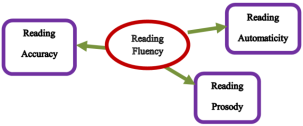
Figure 1 explains reading fluency components.
Figure 1. Reading Fluency Components.
2.3. Related Studies on Reading Fluency
Reading fluency has been understood as one of the chief constituents that excellent nurse readers gain. Lots of investigators have established several methods and procedures for developing reading fluency rates. Erion, and Ronka
| [18] | Erion, J. & Ronka, C. S. (2004). Improving reading fluency with parent tutoring. Teaching Exceptional Children Plus, 1(2), 1-8. Retrieved from
https://files.eric.ed.gov/fulltext/EJ 966508.pdf |
[18]
suggest a process for developing reading fluency that is simple for fathers to study and to use with children. Instructors in the classroom do not have sufficient time to practice enough exercises with children to comprehend fluent reading, so they train parents and request them to do drilling exercises with their children for about half an hour a day. This technique has proven that the method is very effective, and it requires follow-up and a sustained connection between fathers and teachers at schools.
To increase reading fluency, Iwahori
| [26] | Iwahori, Y. (2008). Developing reading fluency: A study of extensive reading in EFL. Reading in a Foreign Language, 20(1), 70-91. Retrieved from:
http://Hawaii.edu/rfl |
[26]
conducted a seven-week study to measure the efficiency of the ER Approach on reading rates of 33 Japanese school participants. They were second-year high school students. The participants were 19 females and 14 males, aged 16 to 17, and they were at a beginner's level. They studied four 50-minute reading classes and two writing classes per week. Graded Readers and comic books were given to participants as reading material for enjoyment. They were required to read a total of 28 books during their studies. Pre-test and post-test of reading rate and language ability were conducted. The t-test was employed to recognise the students' rates and language ability. The reader's rate was scored by calculating the total number of words correct per minute (WCPM), and the reader's score was compared against the target norms. The findings revealed that the ER approach is a useful method to increase participants' reading rate and abilities. As the mean reading rate from the pre-test to the post-test improved from 84.18 to 112.82 wpm, and the growth in general proficiency is small, where p is 0.3.
Similarly, many studies disclosed that the combination of RR and ER plays a major role in the progress of reading fluency. Gorusch, Taguchi, and Takayasu carried out a research over 17 weeks on EFL university learners in Japan
. The study aimed to explore how both RR and ER increase reading fluency. 20 participants were divided equally into two groups, the ER Approach group and the RR Approach group. Pre-tests and post-tests were conducted. Two different texts were utilised, and the time for reading an entire text was calculated. The findings revealed that participants did not gain progress in their reading fluency as the ER group's pre-test result was 80.88, post-test was 64.48, and the RR group's pre-test was 84.84, and post-test was 82.28. However, this method requires a longer time than a 1-minute reading probe, and it is not clear how to decide the appropriate length of a text.
Moreover, for developing reading fluency with a peer-mediated experiment, Edward, and Kristi
| [17] | Edward, J. & Kristi, H. D. (2011). Improving oral reading fluency with a peer-mediated intervention. Journal of Applied Behaviour Analysis, 44(3), 641-646.
https://doi.org/101901/jaba.2011.44-641 |
[17]
did an intervention study. The study explored the positive impact of a peer-mediated experiment on the reading fluency of first-grade students. Answers were calculated as CRW and errors per minute. CRW involved words pronounced accurately within 3 seconds and self-corrections. Errors involved omission, mispronunciation, and hesitation of more than 3 seconds. The findings disclosed that participants' reading fluency improved more.
In addition, Rasinski, and Yildrim
| [32] | Rasinski, T. & Yildrim, K. (2014). Reading fluency beyond English: Investigations into reading fluency in Turkish elementary students. International Electronic Journal of Education, 7(1), 97–106. Retrieved from
https://eric.ed.gov/?id=EJ1053598 |
[32]
conducted a study on reading fluency among Turkish elementary students at Kent State University in the USA. The research aims to examine the effects of various practical implications on the improvement of Turkish students' reading fluency. Data were gathered from the participants’ reading fluency, which included measures of reading automaticity (number of words read correctly per minute), reading accuracy (percentage of words decoded correctly per minute), and prosody (the assessor listening to a reader read the grade-level text and then rate the quality of reading prosody using a specific rubric). The findings revealed that the instructional strategy used in the study is effective in developing participants' reading fluency and could be beneficial if incorporated into the Turkish language curriculum.
To sum up, ER-IR Approaches were applied in many studies for the improvement of learners' reading fluency and its components, automaticity, accuracy, and prosody. The findings of these studies revealed that participants had made improvements in their reading fluency components that lead to a worthy communication among readers.
3. Research Methodology
3.1. Research Design
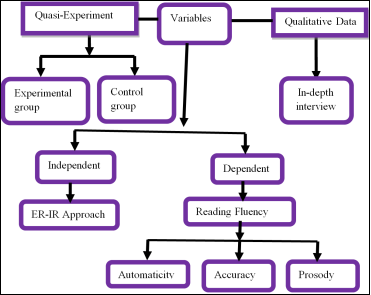
The present study employed a quasi-experimental research design. Cambell, Cook, and Shadish prove that the quasi-experiment was effective because it used "pre-post testing." This indicates that some tests are conducted prior to data collection to determine the exact levels of nurse students' reading fluency and to check for any individual confounds. Subsequently, the actual experiment was carried out, followed by the post-test results. This data could then be compared to the pre-test scores to measure the subjects' progress
| [11] | Cambell, D., Cook, T. & Shadish, W. (2002). Experimental and quasi-experimental designs for generalized causal inference. Boston, NY: Houghton Mifflin. Retrieved from
www.am azon.com13:9780395615560 |
[11]
.
To follow Cattamanchi, Handley, Lyles, and McCulloch's research design, the present study included two basic groups: an experimental group of 18 participants who were exposed to the ER-IR Approach implemented in reading simplified texts, and a control group of 18 participants who were not exposed to any treatment
| [12] | Cattamanchi, A., Handley, M. A., Lyles, C. & McCulloch, C. (2018). Selecting and improving quasi-experimental designs in effectiveness and implementation research. Annual Review of Public Health, 39, 5-25. Retrieved from
https://scholar.ggogle.com |
[12]
.
The study also included two variables: the independent variable, which was the ER-IR Approach, and the dependent variables, which comprised the participants' reading fluency components, including automaticity, accuracy, and prosody. The researchers Gribbons, and Herman added that once the variables had been clearly defined and identified, the procedure was implemented, and group differences were examined
.
On the other hand, the present study favoured a qualitative approach because this method offers flexibility Creswell
. To arrange an interview, the researcher selected appropriate words to formulate the questions. In this regard, the present study aimed to gather information from individuals based on their lifelong experiences and their perceptions of the intervention study, which reflected a broad range of opinions on the deterioration of learners' comprehension and fluency levels. Therefore, Clark, and Creswell decide that a qualitative approach was particularly effective in eliciting such valuable information
.
In conclusion, this quasi-experimental study sought to implement two research methods, as the researcher aimed to find clear, concrete, and complete answers to all the study's research questions, while also wishing to directly fulfil and achieve all the research objectives. Although the two methods employed different tools for data collection and analysis, together, they were effective in providing concrete, valid, and reliable research findings.
Figure 2 illustrates the research design of the study.
Figure 2. Research Design of the Study.
3.2. Population and Sample
The participants in the study were first-year university nurse students enrolled in the PYP at Al Ghad International College in Najran City, Saudi Arabia. There were 120 students registered for the second semester of the academic year 2024/2025.
Given the large total population of 120 students, the purposive sampling technique was utilised to select the sample for this study. Using the availability sampling method, two English classes comprising 36 students were chosen as the sample size to represent the total of 120 students. The participants were male, aged between 18 and 30. They were current learners enrolled in the E105 English Language Course. The course was compulsory (5 credits) in the second semester of the academic year 2024-2025. The nurse students attended 13 lectures per week, each lasting one hour. The course spanned 17 weeks, including two weeks for the midterms and the final English exam. The participants were divided into two equal groups: experimental and control groups. Both groups were instructed by the teacher-researcher from the Department of English Language in the PYP.
Regarding the unstructured interview questions, a total of ten participants who attended the intervention study were selected: five from the experimental group and five from the control group.
Table 1 illustrates the demographic characteristics of the participants.
Table 1. Demographic Characteristics of the Participants.
Group | Gender | No. | Age | Ethnic |
Experimental | Male | 18 | 18-30 | Arab |
Control | Male | 18 | 18-30 | Arab |
Total | | 36 | | |
3.3. Research Instruments for Data Collection
Research instruments refer to the various methods a researcher employs to gather data from participants for their studies. Adedokun discloses that the types of measurement instrument that researchers can utilise depend on the nature of the research being conducted
| [1] | Adedokun, J. A. (2003). Basics of research methodology. Sagamu, Nigeria: New Hope Publication. |
[1]
. In the current study, two primary instruments were used to collect: quasi-experimental data and qualitative data.
3.3.1. Research Instruments for Quasi-experimental Study
The quasi-experimental research involved three research instruments: the intervention materials 'short topics', reading achievement pre-tests, and oral reading fluency assessments, which encompass automaticity, accuracy, and reading prosody.
(i). The Intervention Material: Simplified Topics
The topics utilised in the intervention study comprised simplified, concise texts. Based on Boers, and Lindstromberg, these texts were composed using simple vocabulary and were commonly employed in English as a Foreign Language instruction
| [7] | Boers, F., & Lindstromberg, S. (2012). Experimental and intervention studies on formulaic sequences in a second language. Annual Review of Applied Linguistics, 32, 83-110. |
[7]
. The topics included vocabulary knowledge and grammatical structures suitable for the nurse learners' reading enjoyment as well as their academic levels.
Before the selection of short topics, a pre-test was administered to assess the students' actual level of English proficiency. The results showed that the students were at the elementary level, which is suitable for the chosen topics.
(ii). Reading Fluency Pre-tests
Recent perspectives from certain scholars suggest that reading fluency consists of three distinct components: automaticity, accuracy, and prosody. One of these scholars is Rasinski
| [33] | Rasinski, T. V. (2004). Assessing reading fluency. Honolulu, HI: Pacific Resources for Education and Learning. Retrieved from https://eric.ed.gov/?id=ED483166 |
[33]
, who defines the components of fluency as follows: automaticity is the reader's ability to decode words in a given text effortlessly during reading. Accuracy, on the other hand, refers to the reader's ability to decode words correctly. Prosody relates to the reader's capacity to produce appropriate and accurate expressions and phrases from a specific text.
Among these perspectives, the most prominent and widely accepted theory for understanding reading fluency is the automaticity theory. Sabat
| [38] | Sabat, S. (2024). Fluency and accuracy in English language teaching. Актуальнi Питання Гуманiтарних Наук, 300. |
[38]
mentions, for example, that fluency depends on accurate phrasing and expression. Similarly, Zakirovich
| [45] | Zakirovich, G. B. (2023). Accuracy and fluency in language teaching. International Journal of Social Science & Interdisciplinary Research ISSN: 2277-3630 Impact factor: 8.036, 12(05), 19-25. |
[45]
argues that the main elements of fluency include reading speed, accuracy, and appropriate expressions. Blevins
explains that a fluent reader reads quickly, recognises words automatically, and understands expressions effectively. He added that knowing words automatically characterises the accuracy of word decoding. For these reasons, the researcher conducted three pre-tests separately. These tests were reading rate, reading accuracy and reading prosody. The pre-tests were designed for all participants who attended the intervention study.
(iii) Oral Reading Fluency Assessments
For the present study, reading fluency was assessed using two tests: a pre-test conducted prior to the intervention and a post-test administered afterwards. All participants, both control and experimental groups, completed similar assessments. Two texts, each containing 270 words, were carefully prepared. The difficulty level was evaluated using a readability formula to ensure that the texts matched the students' reading abilities.
To measure the level of automaticity and accuracy, the study used the CBM/ORF approach for assessment. The student was asked to read the text for one minute, and his reading was recorded. Errors such as mispronunciations, omissions, and substitutions were noted as uncorrected words. The automaticity score can be determined by calculating the total number of WCPM and comparing the learner's performance against the target standards.
The accuracy scores can be determined by dividing the number of words read correctly per minute (WCPM) by the total number of words read, including 'WCPM added to uncorrected words'. The score was expressed as a percentage and could be compared against the target norms.
Since quantifying prosody or text interpretation was difficult, the present study aimed to use qualitative rubrics or rating scales to evaluate students' performance in reading prosody. The rubrics were easy to apply and ranged from well-phrased reading to expressive reading, word by word, and monotonic reading.
In assessing reading prosody, Haskina mentions that the student read a grade-level text aloud while the researcher listened attentively. The reading could also be recorded, and the duration is brief, '60 seconds'. At the end of the listening period, the researcher reviewed the rubric and assigned a score that most closely aligned with the learner's reading
| [24] | Haskina, T. (2014). Toward a reliable measure of prosody: An investigation of rater consistency. International Journal of Education and Social Science, 1(5), 102-112. Retrieved from
www.ijessnet.com |
[24]
.
3.3.2. Research Instruments for Qualitative Research Data
The instrument used to collect information from participants was the unstructured interview. Tripathi explains that unstructured interviews are always used in investigative studies to gather qualitative data from individuals. The researcher generally seeks to get clear and deep facts of the problem by contacting respondents and discussing views on several issues related to the problem
.
Moreover, the unstructured interview is one of the most effective methods that support researchers to dig deeper into the problem, to create fruitful discussion and to understand the beliefs and attitudes of the interviewees. In this interview, the researcher used Chadwick, Gill, Stewart, and Treasure's process of data collection as it started with some general topics and then gradually and proficiently led the interviewee towards the direction of his main questions
| [13] | Chadwick, B., Gill, P., Stewart, K. & Treasure, E. (2008). Methods of data collection in qualitative research: Interviews and focus groups. British Dental Journal, 204(6), 291-295.
https://doi.org/10.1038/bdj.2008.192. |
[13]
.
In this concern, Boyce, and Neale
define an in-depth interview as a qualitative research method that comprises conducting intensive individual dialogues with a few subjects to disclose their viewpoints on a certain idea, program, or issue. Thus, in the present study, the researcher allocated ten participants who attended the study, five from the experimental group and five from the control group. He used the in-depth interview to ask them some questions about their experiences and expectations related to the benefits of the intervention study, and the effectiveness of the ER-IR Approach on their reading fluency components, automaticity, accuracy and prosody.
3.4. Research Instruments for Data Analysis
To analyse data collected from participants, the study employed three analyses: descriptive statistics, One Way ANOVA, and box plot analysis.
4. Data Analysis
The present study analysed scores from 36 first-year university nurse students at Al Ghad College in Najran City, along with the interview responses of 10 participants. The study aimed to determine the impact of the ER-IR Approach on enhancing the participants' components of reading fluency during the pre-test and post-test phases of a quasi-experimental design. The results will be presented for analysis in line with the study's research objectives and questions. Data were collected through quantitative measures, including achievement tests for reading fluency, as well as qualitative measures via an unstructured interview.
The data analysis consisted of three subsections that effectively addressed the study's research questions. The first subsection focused on analysing the pre-test results for reading fluency in both experimental and control groups to ensure that all participants had similar levels of reading fluency before the study. Additionally, the pre-test results can be compared with the post-test results to assess the effectiveness of the intervention.
The second subsection analysed the results of the reading fluency pre-test and post-test for both groups, aiming to compare the differences between the experimental and control group participants regarding their reading fluency components: automaticity, accuracy, and prosody.
The third subsection presented an analysis of the structured interview data for both groups, aimed to explore the participants' perspectives on how the role of ER-IR affects their reading fluency.
These findings should be explained in detail in the following points.
4.1. Findings of Quantitative Data
The findings from the quantitative data can be categorised into two sections based on the research questions of the study. These sections are the levels of reading fluency before the study and the levels of reading fluency tests after the study.
(i). Levels of Reading Fluency before the Study
Research Question 1: What are the levels of reading fluency among experimental and control group of nurse students before the intervention study?
In this level, the analysis involved scores of reading fluency components, including reading automaticity, reading accuracy, and reading prosody tests. Concerning reading automaticity, the descriptive statistics presented in
Table 2 indicate that both experimental and control groups had identical scores in the pre-test. This is shown by the mean (29.5 and 28), median (27.8 and 29), and total (531 and 504).
This similarity in scores for both groups was confirmed by the ANOVA analysis in
Table 3, which showed that the distribution of scores for the experimental and control groups was not significantly different (p>0.05).
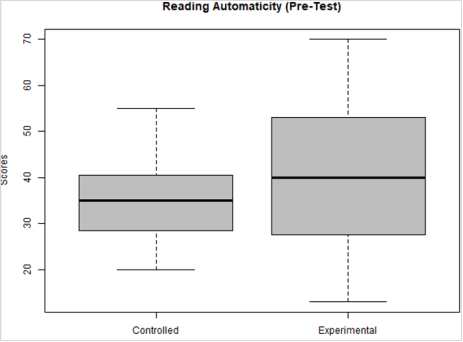
For further confirmation,
Figure 3 shows that both experimental and control groups have a similar range of scores. Since there were no significant differences between the scores of the two groups, the participants had identical levels of reading automaticity before the study.
Table 2. Descriptive Statistics for Reading Automaticity Pre-test.
Source | Mean | Median | Mode | SD | Sum | Kurt | Skn |
Experimental Group | 29.5 | 27.8 | 29 | 8 | 531 | 0.3 | 0.24 |
Control Group | 28 | 29 | 28 | 6 | 504 | 0.04 | 0.18 |
N=36
Table 3. The ANOVA Analysis for Reading Automaticity Pre-test.
Source | Sum | Average | Variance | Sum of Squares | Degree of Freedom | Mean Squar | P-value |
Experimental | 576 | 32 | 95.6 | | | | |
Control | 558 | 31 | 56 | | | | |
Bet. Group | | | | 26.9 | 1 | 19.9 | 0.7233 |
Within Group | | | | 3829.4 | 42 | 56.2 | |
Total | | | | 3846 | 39.5 | | |
N= 36
Figure 3. Box Plot Showing Reading Automaticity Pre-test.
Regarding the reading accuracy test,
Table 4 summarises the scores of a pre-test for both experimental and control groups. It shows that the scores were almost similar for both groups, with a mean of 31 and 30.7, a median of 34 and 29.7, and a mode of 32 and 31 respectively.
This fact of a similar level of reading accuracy for both groups was also supported by ANOVA analysis in
Table 5. It revealed that there was no significant difference between the scores of the experimental and control groups, with averages of 32 and 30, sums of 576 and 540, and a P-value of 0.241 (greater than 0.05).
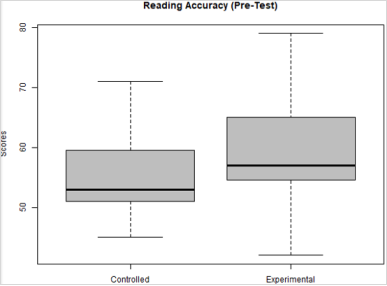
Similarly, the box plot analysis in
Figure 4 showed that both experimental and controlled groups had similar score distributions in reading accuracy before the intervention study.
Table 4. Descriptive Statistics for Reading Accuracy Pre-test.
Sourc | Mean | Median | Mode | SD | Sum | Kurt | Skn |
Experimental Group | 31 | 34 | 32 | 4.1 | 528 | 0.7.1 | 0.04 |
Control Group | 30.7 | 29.7 | 31 | 3.5 | 552.6 | 0.06 | 0.45 |
N = 30
Table 5. ANOVA Analysis for Reading Accuracy Pre-test.
Source | Sum | Average | Variance | Sum of Square | Degree of Freedom | Mean Square | P-Value |
Exp. Group | 576 | 32 | 42 | | | | |
Cont. Group | 540 | 30 | 23.9 | | | | |
Bet. Group | | | | 46.75 | 1 | 47.11 | 0.241 |
Within Group | | | | 1829 | 44 | 34 | |
Total | | | | 1846 | 43 | | |
N = 36
Figure 4. Box Plot for Reading Accuracy Pre-test.
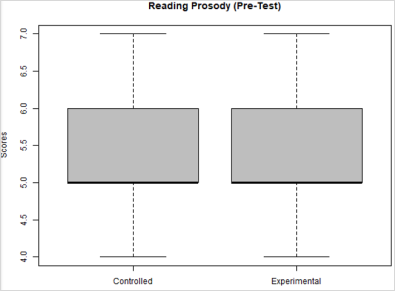
The final component of reading fluency is reading prosody, whose findings are presented in
Table 6. The participants of both groups exhibited almost identical levels of reading prosody, as indicated by the mean (5.6 and 5.4), the median (4.8 and 4.7), and the mode (5.3 and 5.2).
Table 7 displays the analysis of reading prosody scores using the ANOVA test. The results also show that there were no significant differences between the reading prosody scores of both the experimental and control groups. Therefore, the means are (5.6 and 5.4), the variances are (0.68 and 0.63), with (p>0.05). For further verification,
Figure 5 illustrates that both the experimental and control groups had a similar range of distribution. This indicates that all participants shared comparable levels of reading prosody before the intervention.
Table 6. Descriptive Statistics for Reading Prosody Pre-test.
Source | Mean | Median | Mode | SD | Sum | Kurt | Skn |
Experimental Pre-test | 5.6 | 4.8 | 5.3 | 0.79 | 101 | -.37 | .026 |
Control Pre-test | 5.4 | 4.7 | 5.2 | 0.7.7 | 97.8 | -.31 | .024 |
N = 36
Table 7. ANOVA Analysis for Reading Prosody Pre-test.
Source | Sum | Averag | Variance | Sum of Square | Degree of Freedom | Mean Square | P-valu |
Experimental | 100.8 | 5.6 | 0.68 | | | | |
Control | 97.2 | 5.4 | 0.63 | | | | |
Bet. Group | | | | 0.282 | 1 | 0.076 | 0.689 |
Within Group | | | | 18.3 | 36 | 0.711 | |
Total | | | | 19.22 | 35 | | |
N = 36
Figure 5. Box Plot for Reading Prosody Pre-test.
In summary, the analysis of all participants' scores from the reading fluency components showed that all participants had similar levels of reading fluency before the intervention study.
(ii). Levels of Reading Fluency Tests
Research Question 2: To what extent do experimental group of nurse students perform better in reading fluency post-test scores than pre-test scores due to the effects of the intervention study?
The analysis of reading fluency test scores can be categorised into three main levels: reading automaticity levels, reading accuracy levels, and reading prosody levels.
(a). Levels of Reading Automaticity Test
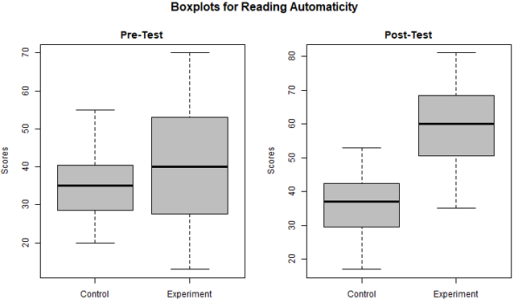
Table 8 displays the scores of reading automaticity pre-test and post-test for the experimental and control groups. Both groups had similar scores in the pre-test, with means of 32.2 and 32.9, medians of 33 and 33, and modes of 34 and 32, respectively. The table also reveals that participants in the experimental group scored higher in the post-test than those in the control group, with means of 54.8 and 33.1, medians of 55 and 34, and modes of 69 and 35, respectively.
Table 8. Descriptive Statistics for Reading Automaticity Test.
Source | Mean | Median | Mode | SD | Sum | Kurt | Skn |
Experimental | | | | | | | |
Pre-test | 33.2 | 33 | 34 | 13 | 612 | -0.49 | 0.50 |
Post-test | 54.8 | 55 | 69 | 10 | 986.4 | -0.34 | -0.36 |
Control | | | | | | | |
Pre-test | 32.9 | 33 | 32 | 7 | 594 | 0.065 | 0.41 |
Post-test | 33.1 | 34 | 35 | 7.4 | 596 | -0.24 | -0.27 |
N = 30
Accordingly, the findings in
Table 9 indicate that there were statistically significant differences between the post-test scores of the experimental and control groups, as the P-value (1.44E-7) is less than 0.05. This demonstrates a successful improvement in the reading automaticity post-test scores of the experimental students. This enhancement in the post-test scores of the experimental group was confirmed in
Figure 6. The findings showed that in the pre-test, both groups had a similarly distributed range of scores, while in the post-test, the score distribution range of the experimental group was wider than that of the control group.
Figure 6. Box Plot of Reading Automaticity Test.
Table 9. ANOVA Analysis of the Reading Automaticity Test.
Source | Sum | Averag | Variance | Sum of square | Degree of freedom | Mean Squar | P-Value |
Experim. | 986.4 | 54.8 | 127.3 | | | | |
Control. | 597.6 | 33.2 | 68.4 | | | | |
Between Groups | | | | 4130.2 | 1 | 41130.5 | 1.44E-7 |
Within Groups | | | | 2988.85 | 34 | | |
Total | | | | 7119.05 | 35 | | |
N= 36
(b). Levels of Reading Accuracy Test
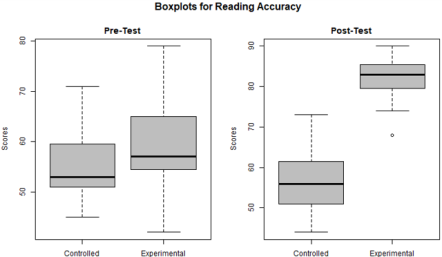
Table 10 summarises the results of reading accuracy pre-test and post-test scores for the experimental and control groups. The participants in both groups achieved relatively similar scores in the pre-test, with the mean (53 and 52.7), the median (54 and 53), and the mode (53 and 59), respectively. The findings also revealed that the experimental group scored higher in the post-test compared to the control group participants, with the mean (78.8 and 54), the median (78 and 54), and the mode (79 and 60), respectively.
Similarly,
Table 11 revealed that there were statistically significant differences between the post-test scores of the experimental and control groups, as the P-value (2.98E-18) was less than 0.05. This indicates that participants in the experimental group showed notable improvement in their reading accuracy after the test. To confirm this,
Figure 7 was used. It showed that, in the pre-test, both the experimental and control groups had a similar score distribution, while in the post-test, the experimental group displayed a wider range of scores compared to the control group.
Table 10. Descriptive Statistics for the Reading Accuracy Test.
Source | Mean | Median | Mode | SD | Sum | Kurt | Skn |
Experimental | | | | | | | |
Pre-test | 53 | 54 | 53 | 7 | 954 | -0.101 | -0.064 |
Post-test | 78.8 | 78 | 79 | 5.5 | 1418.4 | 0.91 | -1.08 |
Control | | | | | | | |
Pre-test | 52.7 | 53 | 59 | 5.9 | 948.6 | -0.06 | 0.41 |
Post-test | 54 | 54 | 60 | 6.6 | 972 | -0.08 | 0.26 |
N=30
Table 11. The ANOVA Analysis for Reading Accuracy Test.
Source Post- | Sum | Average | Variance | Sum of Squares | Degree of Freedom | Mean Squar | P-Value |
Exp. Test | 1422 | 79 | 38 | | | | |
Cont. test | 954 | 53 | 44.4 | | | | |
Bet. Group | | | | 4826 | 1 | 4826 | 2.98E-18 |
Within Group | | | | 1296.4 | 35 | 44.7 | |
Total | | | | 6122.4 | 35 | | |
N=36
Figure 7. Box Plot for Reading Accuracy Test.
(c). Levels of Reading Prosody Test
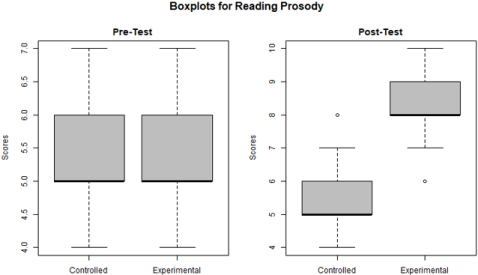
Table 12 displays the pre-test and post-test scores of the experimental and control groups. It shows that participants in both groups had similar scores in the pre-test; therefore, the mean (5 and 4.9), the median (5.2 and 5), and the mode (4.8 and 4.9) were comparable. However, in the post-tests, the experimental group achieved higher scores than the control group, with the mean (7.8 and 5.3), the median (7.9 and 5.2), and the mode (8 and 5).
To determine whether this improvement was statistically significant,
Table 13 should be consulted. It revealed that there were statistically significant differences between the post-test scores of participants in the experimental group and those in the control group, with the average scores (7.8 and 4.6), the variances (0.89 and 0.71), and the totals (140.4 and 82.8), respectively. The p-value (p<0.05) confirmed the significant improvement in the experimental group's post-test scores.
Accordingly,
Figure 8 also presents the score distribution of reading prosody pre-test and post-test for participants in the experimental group compared to the pre-test and post-test scores of the control group. The findings reveal that in the pre-test, both groups exhibited a similar range of scores, whereas in the post-test, the score range for the experimental group was broader than that of the control group.
Table 12. Descriptive Statistics for the Reading Prosody Test.
Source | Mean | Median | Mode | SD | Sum | Kurt | Skn |
Exp. Pre-test | 5 | 5.2 | 4.8 | 0.85 | 91 | -0.25 | 0.038 |
Exp. Post-test | 7.8 | 7.9 | 8 | 0.99 | 141 | 1.5 | 0.41 |
Cont. Pre-test | 4.9 | 5 | 4.9 | 0.7 | 88.2 | -0.35 | 0.038 |
Cont. Post-test | 5.3 | 5.2 | 5 | 0.8 | 83 | 0.9 | 0.33 |
N = 36
Table 13. ANOVA Analysis for Reading Prosody Test.
Source | Sum | Average | Variance | Sum of Square | Degree of Freedom | Mean Square | P-value |
Exp. Post-test | 140.4 | 7.8 | 0.89 | | | | |
Cont. Post-test | 82.8 | 4.6 | 0.71 | | | | |
Bet. Group | | | | 75.4 | 1 | 59.4 | 0.00 |
Within Group | | | | 36 | 35 | 0.6 | |
Total | | | | 111.4 | 36 | | |
N = 30
Figure 8. Box Plot for Reading Prosody Test.
4.2. Findings of Qualitative Data
Research Question 3: What are the views of the experimental group and control group students towards the effective role of the ER-IR Approach in their reading fluency?
The qualitative data were collected from ten students through structured interviews, with the students referred to as S1 to S10 in the results' description. The main aim of the interview was to explore the respondents' perceptions of the impact of English Literary Studies on their reading fluency following the intervention. The analysis of qualitative data concentrates on the participants' views regarding the effect of the ER-IR Approach on their reading fluency components—automaticity, accuracy, and reading prosody.
According to the interview report, most respondents believed that the ER-IR Approach included factors that positively affected their reading fluency. These factors were reading "simplified topics", decoding words, and reading practice.
Many participants stated that simplified texts were the main factor that had a positive influence on their reading fluency. Therefore, S2 reported that 'reading many simple texts helped me to read simple phrases correctly'. S4 mentioned that 'I am able to read short sentences because I was reading many topics every week'. Also, S5 reported that 'Before the study, I was reading a sentence word by word, and I was taking a long time to read it. But now I can read a sentence, and I can't stop at every word.
Additionally, decoding words with phonics and phonemics was another main issue that improved students' reading fluency. Most respondents reported that the ways of decoding words increased their reading fluency. For instance, S1, S8, and S5 claimed that at the phoneme level, decoding "ch, sh, and ph " with a lot of examples supported the pronunciation of some words and reading sentences accurately. At the syllable level, decoding some prefixes and suffixes such as " un-, re, -ity, and –tion" (S9) and demonstrating them (S6) encouraged reading automaticity and reading prosody.
Moreover, some respondents reported that identifying the similarities and differences of word families, 'e.g., speak, spoke, spoken, speaker, S8, with various new words (S10, S3 and S7) was a correct way to develop reading accuracy and reading prosody.
Furthermore, the most effective factor that had a positive influence on respondents' reading fluency was reading practice. Most respondents mentioned that reading practice, including repeated reading, choral reading, and teacher modelling, increased their reading fluency. It was agreed that reading fluency developed when the teacher brought a written text, discussed its elements with an expressive way of reading 'e.g. rate, pitch and intonation' with them (S3 and S4). They confirmed that the teacher selected the reading text and modelled it for his students was an essential reason to improve students' reading fluency (S10, S1 and S7). Then the students practised reading topics loudly by themselves regularly (S6 and S8).
In brief, participating in various types of exercises, using different teaching methods, expanding vocabulary knowledge, building language structures, reading short texts, decoding words, and increasing reading practice are the main factors that motivate respondents to enhance their reading fluency components, such as automaticity, accuracy, and prosody.





 Share This Article
 Twitter
 Linked In
 Facebook
 Copy
Copy Download