Abstract
Inclusive education in India signifies a constitutional, philosophical, and pedagogical movement toward equity, dignity, and human rights. Grounded in both indigenous educational thought and global frameworks such as the Salamanca Statement and Sustainable Development Goal 4 (SDG 4), it envisions schools where every learner, irrespective of caste, gender, ability, language, or socioeconomic background, can learn and participate fully. This theoretical study analyzes the evolution of inclusive education from pre-independence reform movements to contemporary frameworks such as the Right to Education Act (2009), Rights of Persons with Disabilities Act (2016), National Education Policy (2020), and National Curriculum Framework for School Education (2023). Using a PRISMA informed systematic review of key documents, this study traced historical development, reviews constitutional and policy provisions, examines inclusive pedagogical practices, and identifies persistent challenges. The findings show that India has developed a strong legal and policy framework to support inclusive education. Recent reforms emphasize multilingual learning, flexible curriculum, competency based assessment, digital access, and teacher training. However, several challenges remain. Inadequate infrastructure, limited teacher preparation, rigid examination systems, digital inequality, and social biases continue to restrict full participation of marginalized learners. The study concludes that inclusive education must go beyond policy statements and become a lived classroom practice. Achieving “learning without boundaries” requires better teacher support, improved infrastructure, coordinated governance, and a change in mindset that values diversity as a strength rather than a limitation.
Keywords
Equality, Equity, Inclusive Education, NCFSE 2023, NEP 2020, Pedagogy, PRISMA, RTE 2009, Social Justice
1. Introduction
Inclusive education means all learners, regardless of disability, gender, caste, language, or background, learn together in regular schools with proper support. It focuses on equal access, participation, and respect for every child. The goal is to remove barriers, create a positive learning environment, and help all students succeed socially and academically. It follows human-rights principles and promotes fairness and dignity for every learner. Education is universally acknowledged as both a human right and a public good. In the Indian context marked by deep social, linguistic, and economic diversity it functions as an essential instrument for national integration and social transformation
. Yet, for much of India’s history, access to education mirrored structural inequities. Inclusive education arose as a corrective vision, demanding that the school system adapt to learner diversity rather than expecting learners to conform to fixed norms.
Globally, inclusive education evolved through landmark events such as the
Jomtien Conference on Education for All (1990),
Salamanca Statement (1994), and
Dakar Framework for Action (2000), which reframed schooling from access to participation and from special education to mainstream inclusion.
. India, a signatory to these frameworks, translated them into a rights-based agenda through the
Sarva Shiksha Abhiyan (2001),
Right to Education Act (2009),
Rights of Persons with Disabilities Act (2016), and
National Education Policy (2020).
Philosophically, inclusion resonates with Indian reformist thought. The Upanishadic maxim Sa Vidya Ya Vimuktaye (“Knowledge is that which liberates”) and the teachings of Swami Vivekananda, Rabindranath Tagore, Mahatma Gandhi, and B. R. Ambedkar all position education as a means of freedom and social justice. Contemporary frameworks such as the NEP 2020 and NCFSE 2023 extend this legacy by embedding inclusion across curriculum, pedagogy, and assessment.
Despite substantial progress, empirical data reveal persistent inequalities. The
Unified District Information System for Education Plus UDISE+ 2022 reports a Gross Enrollment Ratio of 103.4 percent at the primary level but only 79.6 percent at the secondary level, while children with disabilities represent barely 1.2 percent of total enrollment
. These patterns underline the urgency of studying inclusive education not only as a legal commitment but as a lived classroom reality.
This paper seeks to synthesize historical, policy, and pedagogical dimensions to understand how India can move from access to genuine participation ensuring every learner experiences belonging, dignity, and empowerment.
2. Need and Relevance of Inclusive Education in 21st-century India
In today’s globalized and digitized world, inclusion is not merely an educational reform, it is a national necessity. As India strives to become a Global knowledge society, it cannot afford to leave any section behind. Inclusive education addresses multiple challenges simultaneously: Equity and Social Justice: Ensures fair distribution of resources and opportunities. Economic Development: Empowers marginalized populations to contribute to national productivity. Social Cohesion: Fosters empathy, tolerance, and unity in a pluralistic society. Sustainable Development: Aligns with SDG-4, linking education with environmental, economic, and social sustainability.
Inclusive education, therefore, is a multidimensional approach combining policy, pedagogy, community participation, and ethical responsibility. It seeks to transform the classroom from a space of competition to a space of collaboration — where differences become strengths and every learner’s identity is affirmed.
3. Objectives of the Study
1) To trace the historical development of inclusive education in India from pre- to post-independence.
2) To analyze contemporary classroom practices and pedagogical strategies that support inclusive learning.
3) To identify challenges and suggest practical recommendations for realizing inclusive education in India.
4. Research Questions
1) How has inclusive education in India evolved historically from pre-independence to post-independence?
2) What contemporary classroom practices and pedagogical strategies support inclusive learning in India?
3) What are the major challenges in realizing inclusive education in India, and what practical recommendations can address these challenges?
5. Methodology
Research Design
The present study follows a qualitative hermeneutics approach, focusing on theoretical interpretation rather than empirical measurement. Since the purpose of the research is to trace, interpret, and critically evaluate the evolution of inclusive education in India, it relies exclusively on secondary sources such as books, peer-reviewed journals, government policy documents, and international reports
| [7] | Creswell, J. W., & Poth, C. N. (2018). Qualitative inquiry and research design: Choosing among five approaches (4th ed.). SAGE Publications. |
[7]
.
Data Sources
Data for this study were drawn from four broad categories of sources. These included constitutional and legal texts such as the Constitution of India (1950), the Right to Education Act (2009), and the Rights of Persons with Disabilities Act (2016). Policy and institutional reports comprised National Education Policies, Samagra Shiksha, National Curriculum Frameworks, and UDISE+ data. The review also included peer-reviewed academic literature and key international frameworks like UNESCO Report.
Analytical Framework
Research Contribution and Audience
This theoretical paper contributes in four interrelated ways. First, it reconstructs the historical and philosophical genealogy of inclusion in India, linking reformist visions with contemporary policy. Second, it critically synthesizes policy frameworks and curricular reforms to identify persistent gaps. Third, it articulates a theoretically grounded pedagogical framework that integrates UDL, differentiated instruction, multilingualism, and formative assessment. Fourth, it proposes governance and financing pathways to operationalize inclusion at scale.
The intended audience includes academic scholars of education and social policy, teacher educators, curriculum specialists, and policymakers in central and state education departments. Importantly, the paper targets practitioners seeking theoretically robust yet practical guidance to redesign classrooms and teacher training programs.
Ethical and Scholarly Considerations
Working with a theoretical, document-based method requires careful attention to source triangulation and interpretive rigor. The study follows PRISMA-informed selection criteria for literature inclusion to ensure transparency
| [31] | Moher, D., Liberati, A., Tetzlaff, J., & Altman, D. G. (2009). Preferred reporting items for systematic reviews and meta-analyses: The PRISMA statement. PLoS Medicine, 6(7), e1000097. https://doi.org/10.1371/journal.pmed.1000097 |
[31]
. Ethical considerations include responsible representation of marginalized groups and sensitivity to contested historical interpretations
| [33] | Nambissan, G. B. (2012). Exclusion and discrimination in schools: Experiences of Dalit children. Indian Institute of Dalit Studies Working Paper Series, 3(3), 1–28.
https://doi.org/10.2139/ssrn.2188574 |
[33]
. The analysis privileges voice and agency for historically excluded learners while remaining critical of policy rhetoric detached from practice.
Inclusion and Exclusion Criteria
The review applied clear inclusion and exclusion criteria following PRISMA guidelines to ensure relevance and quality. Studies were included if they focused on inclusive education within India or in comparable developing contexts and provided conceptual, policy-related, or pedagogical insights. Literature addressing historical foundations, constitutional provisions, national policies, classroom practices such as UDL or differentiated instruction, teacher education for inclusion, and challenges faced by marginalized learners was considered. Only peer-reviewed articles, academic books, and official reports from recognized bodies such as NCERT, NCTE, UDISE+, the Ministry of Education, and UNESCO were included. Eligible studies were required to be in English, conceptually clear, methodologically sound, and available in full text.
Studies were excluded if they addressed only clinical or diagnostic aspects of disability, lacked educational relevance, focused exclusively on foreign contexts without applicability to India, or did not meet academic standards. Non-scholarly sources, duplicate records, and studies without accessible full texts were also removed.
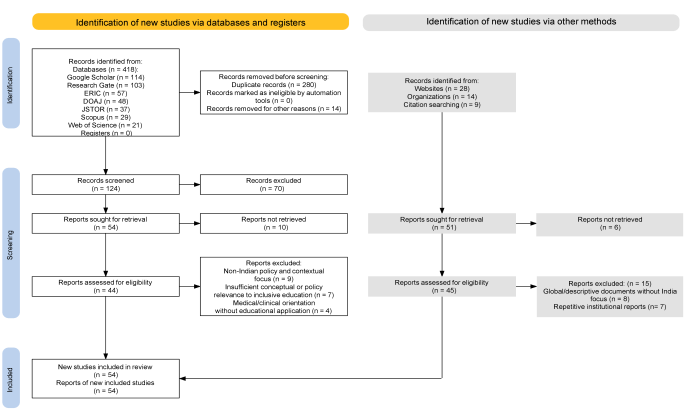
A PRISMA-based systematic review approach was adopted to ensure transparency and reproducibility
| [17] | Haddaway, N. R., Page, M. J., Pritchard, C. C., & McGuinness, L. A. (2022). PRISMA2020: an r package and shiny app for producing PRISMA 2020-compliant flow diagrams, with interactivity for optimised digital transparency and open synthesis. Campbell Systematic Reviews, 18(2), e1230.
https://doi.org/10.1002/cl2.1230 |
[17]
. Sources were identified, screened, and categorized thematically under four dimensions: (a) historical and philosophical foundations, (b) policy and legislative frameworks, (c) pedagogical and institutional practices, and (d) challenges and future directions.
The primary aim of this section is to synthesize how inclusion has evolved theoretically and operationally within India’s educational landscape, contextualized within both indigenous reform traditions and international frameworks.
Validation and Limitations
Triangulation across government reports, academic studies, and international frameworks minimized interpretive bias. However, since the study is theoretical, it cannot provide empirical generalizations of classroom outcomes. Variations across Indian states and linguistic regions may also lead to uneven representation.
Ethical Considerations
All data are secondary and publicly available. Citations follow APA 7th edition to maintain academic integrity. Interpretations privilege the voices of marginalized groups as represented in credible literature
| [33] | Nambissan, G. B. (2012). Exclusion and discrimination in schools: Experiences of Dalit children. Indian Institute of Dalit Studies Working Paper Series, 3(3), 1–28.
https://doi.org/10.2139/ssrn.2188574 |
[33]
.
Figure 1. Prisma Flow Diagram.
6. Historical Evolution of Inclusive Education in India
Pre-Independence: Education as Privilege
Historically, education in India was revered as
Vidya the pursuit of spiritual and moral knowledge but its access was deeply restricted by caste, class, and gender. A comprehensive historical overview of education in India from ancient through colonial periods and explicitly discuss how social hierarchies such as caste, class, and gender shaped access to education and opportunities over centuries
. The
Gurukul system promoted moral discipline and character formation but served mainly upper-caste males. Women, Dalits, and tribal groups were systematically excluded. The medieval introduction of
madrasas and
maktabs broadened intellectual discourse but did not democratize learning.
Despite these exclusions, Indian philosophy emphasized the liberating function of knowledge. The Upanishadic ideal, Sa Vidya Ya Vimuktaye (“knowledge is that which liberates”), symbolized education as emancipation a moral foundation later reclaimed by reformers.
Colonial Modernization without Equality
British colonial education (1757–1947) institutionalized modern schooling through policies such as
Macaulay’s Minute (1835) and
Wood’s Dispatch (1854), but the intent was administrative rather than egalitarian
| [19] | Kambala, Y. J., & Ramakrishna, M. (2023). The impact of British colonial rule on the Indian education system: collapse and deterioration. International Journal of Current Innovations in Advanced Research, 6(3), 1–12.
https://doi.org/10.47957/ijciar.v6i3.188 |
[19]
. English education created an elite class “Indian in blood and color, but English in taste and intellect.” Mass education remained underfunded; female literacy in 1941 was below 9%
.
Nevertheless, colonial exposure introduced modern rationalism, scientific thought, and democratic ideas that shaped reformist and nationalist visions of inclusive education.
Social Reform and the Democratization of Learning
Colonial-era educational reformers challenged social inequality and laid the foundation for inclusive and socially just education in India
| [38] | Pathak, R. (2011). Educational reformers in colonial India. Indian Educational Review, 49(1), 67–81. |
[38]
. The nineteenth century marked a moral awakening. Reformers across India linked education with emancipation:
1) Jyotirao and Savitribai Phule (1848): Founded India’s first schools for Dalits and girls; viewed education as the key to destroying caste-based subjugation.
2) Raja Ram Mohan Roy (1820s): Advocated English and modern education for both sexes to challenge superstition.
3) Ishwar Chandra Vidyasagar (1850s): Advanced women’s education and widow remarriage through education.
4) Rabindranath Tagore (1921): Established Visva-Bharati, blending art, nature, and freedom—his ideal of “learning without walls.”
5) Mahatma Gandhi (1937): Nai Talim or Basic Education emphasized the dignity of labor and experiential learning for equality.
6) B. R. Ambedkar (1940s): Declared education “the milk of the lioness” that empowers the oppressed.
These reformers redefined education as a moral right and a tool of social justice, forming the ethical foundation of inclusive education in modern India.
The Sargent Report (1944): A Blueprint for Universal Education.
The
Sargent Report (1944) proposed free, compulsory schooling for children aged 6–14 within forty years. It stressed gender parity, vocational training, and special education for children with disabilities. Though unrealized under colonial rule, it influenced post-independence educational planning
.
7. Post-independence Development: From Rights to Reform
Constitutional Foundations
After independence, the framers of the Indian Constitution recognized education as the foundation of democracy, equality, and national development. They viewed schooling not only as a social service but as a powerful instrument of social justice, especially for historically marginalized communities. Several constitutional provisions directly or indirectly promote inclusive education.
Article 14 guarantees equality before the law, ensuring that every learner receives equal opportunity in schooling. Article 15 prohibits discrimination based on religion, race, caste, sex, or place of birth, making it unconstitutional for schools or institutions to deny admission or treat children differently. Article 17, which abolishes untouchability, establishes the moral foundation of caste-inclusion in public spaces, including schools.
A major milestone came with the 86th Constitutional Amendment (2002), which inserted Article 21A and made free and compulsory education for children aged 6–14 a fundamental right. This amendment positioned education as a legally enforceable right rather than a welfare measure. Correspondingly, Article 45, under the Directive Principles, was reframed to emphasize early childhood care and education for all children below six years of age, strengthening the foundation stage. Article 46 directs the State to promote the educational and economic interests of Scheduled Castes, Scheduled Tribes, and weaker sections, thereby embedding inclusion in policy planning. In addition, Article 29 (1) protects the cultural and linguistic rights of minorities, supporting inclusive schooling through mother-tongue instruction and respect for diversity. Article 30 grants minorities the right to establish and administer educational institutions, ensuring representation and participation. Provisions such as Article 51A (j), which highlights the duty to strive toward excellence, and Article 38, which promotes social justice, further support an inclusive vision where all children can progress regardless of background.
Together, these provisions created a robust constitutional framework that views inclusion not as charity but as a right, transforming education into a democratic space where equity, dignity, and participation form the core of nation-building.
Educational Commissions and Early Policy (1948–1968)
In the initial post-independence decades, national education commissions played a crucial role in shaping India’s commitment to equality in schooling. The University Education Commission (1948–49), led by Dr. S. Radhakrishnan, emphasized moral development, social cohesion, and equal opportunity as core aims of national education
. The Secondary Education Commission (1952–53) highlighted the need for diversified and flexible curricula to accommodate learners’ varied interests and abilities, anticipating later ideas of inclusive pedagogy
.
The most influential body, the Indian Education Commission (1964–66), articulated a comprehensive vision for educational reform. Its statement,
“The destiny of India is being shaped in her classrooms,” underscored the centrality of school education in social transformation. It strongly recommended the Common School System (CSS) to ensure equity, accessibility, and social integration
. These recommendations informed the National Policy on Education (1968), which formally adopted equality and quality as national priorities, marking India’s first structured move toward inclusive education
.
Education for Equality: The 1986 Policy
The National Policy on Education (1986) marked a major shift from expanding access to ensuring equity, introducing the framework of
Education for Equality. The policy explicitly identified women, Scheduled Castes, Scheduled Tribes, and children with disabilities as priority groups requiring targeted interventions. It strengthened the Integrated Education for Disabled Children (1974) scheme, expanded school infrastructure through Operation Blackboard (1987), and launched Mahila Samakhya (1989) to promote women’s empowerment and participation in education. To improve teacher preparation, the policy established District Institutes of Education and Training (DIETs) across the country
. These reforms were further detailed and implemented through the Programme of Action (1992), which stressed decentralized planning, school–community engagement, and participatory management for achieving educational equity.
Rights-Based Inclusion (1990–2009)
The period from 1990 to 2009 marked a decisive movement from welfare-oriented approaches to a rights-based conception of inclusion in India. The Persons with Disabilities Act (1995) was the first comprehensive legislation guaranteeing equal educational opportunities, non-discrimination, and institutional support for learners with disabilities
| [13] | Government of India. (1995). The Persons with Disabilities (Equal Opportunities, Protection of Rights and Full Participation) Act, 1995. Ministry of Law and Justice.
https://legislative.gov.in/ |
[13]
. This was followed by the launch of the Sarva Shiksha Abhiyan (SSA) in 2001, which aimed to universalize elementary education through school expansion, community participation, and targeted interventions for marginalized children
. The rights-based shift culminated in the Right to Education (RTE) Act, 2009, which made free and compulsory schooling a fundamental right for all children aged 6–14. A landmark provision of the Act, Section 12 (1)(c), mandated private schools to reserve 25% of seats for economically and socially disadvantaged children, ensuring integration across socio-economic boundaries
. Together, these reforms transformed inclusion from policy aspiration into legally enforceable entitlement, setting the foundation for contemporary inclusive education frameworks.
Systemic Inclusion (2010–2024)
The period from 2010 to 2024 marks India’s transition from fragmented interventions to a systemic, integrated, and rights-based approach to inclusive education. In this phase, inclusion is treated not only as access but as meaningful participation, equity, and quality across all stages of schooling. Several major policies, committees, and frameworks during this period significantly shaped the inclusive education landscape.
A landmark reform was the Rights of Persons with Disabilities (RPwD) Act, 2016, which expanded disability categories from 7 to 21 and mandated reasonable accommodation, barrier-free infrastructure, individualized education plans (IEPs), assistive devices, and the presence of special educators in regular schools
. This Act made inclusion a legal obligation and strengthened the rights-based approach to disability education.
The Samagra Shiksha Abhiyan (2018) unified earlier schemes SSA, RMSA, and Teacher Education into a single program covering pre-primary to Grade 12. It introduced a continuum approach to schooling and provided funding for resource rooms, special educators, home-based education, Braille books, large-print materials, hearing aids, transport allowance, and inclusive classroom practices. State-level Inclusive Education Cells and resource centres were institutionalized under this mission
| [30] | Ministry of Human Resource Development, Government of India. (2018). Samagra Shiksha: An integrated scheme for school education. Government of India.
https://samagra.education.gov.in/ |
[30]
.
Several committees also contributed to inclusive policy development. The Justice Verma Committee (2012) restructured teacher education, emphasizing inclusive pedagogy and strengthening DIETs and SCERTs. The Kasturirangan Committee (2019), responsible for drafting NEP 2020, recommended UDL, mother-tongue-based schooling, and structured support for SEDGs. CBSE and NCERT committees (2019–2023) introduced inclusive assessment guidelines, including accommodations for children with disabilities. Accessibility Guidelines (2014, 2019) mandated ramps, tactile paths, accessible ICT, and barrier-free design.
The National Education Policy (NEP 2020) represents a holistic shift by treating inclusion as a
fundamental guiding principle. It introduced Gender Inclusion Funds, Special Education Zones (SEZs), and structured support for Socio-Economically Disadvantaged Groups (SEDGs) such as SCs, STs, OBCs, minorities, migrant children, casteless communities, transgender learners, and children with disabilities. NEP emphasized mother-tongue instruction, Universal Design for Learning (UDL), competency-based education, flexible pathways, and socio-emotional learning. It also strengthened teacher education through new B. Ed. reforms, continuous professional development, and digital training platforms like DIKSHA and NISHTHA
.
The National Curriculum Framework (NCFSE 2023) operationalizes NEP’s inclusive vision through UDL, multilingual pedagogy, experiential learning, and formative assessment practices that support diverse learner needs. It promotes inclusive textbooks, culturally responsive content, and flexible learning processes
.
Despite this architecture, the policy-to-practice translation remains weak.
UDISE+ (2022) reports that while enrollment of marginalized groups has improved, learning outcomes and inclusion of children with disabilities lag behind. Attitudinal resistance and lack of teacher training persist as major bottlenecks
.
Table 1. Chronological Milestones in Indian Inclusive Education.
Period | Focus | Major Policies / Acts | Key Outcome |
Pre-1947 | Restricted Access | Gurukul, Colonial Schools | Exclusion by caste & gender |
1947–1968 | Expansion with Equity | Kothari Commission, NPE 1968 | Common School System |
1986–1992 | Education for Equality | NPE 1986, POA 1992 | Integration, women’s empowerment |
1995–2009 | Rights-Based Inclusion | PWD Act 1995, RTE 2009 | Legal entitlement |
2010–2025 | Systemic Inclusion | NEP 2020, NCF 2023 | UDL, holistic learning, SDG-4 alignment |
8. Pedagogical and Institutional Practices
Universal Design for Learning (UDL)
Universal Design for Learning (UDL) offers a flexible pedagogical framework that supports diverse learners by reducing barriers to learning. As outlined by CAST (2018), UDL is built on three core principles. Multiple Means of Representation ensure that content is presented through varied formats text, visuals, audio, demonstrations to support different learning needs. Multiple Means of Action and Expression allow students to show their understanding through writing, speaking, drawing, or digital formats. Multiple Means of Engagement promote motivation by using relevant examples, learner choice, and culturally meaningful contexts
. Both NEP 2020 and NCF 2023 strongly recommend integrating UDL into curriculum design, teaching strategies, and assessment to enhance accessibility, participation, and equitable learning for all students.
Learner-Centered and Constructivist Pedagogy
NCF 2023 promotes learner-centered and constructivist classrooms where students actively build understanding through dialogue, exploration, and reflection
. Influenced by Dewey’s view of education as a democratic experience (1916) and Freire’s emphasis on dialogic learning (1970), this approach shifts teaching from one-way transmission to shared meaning-making
. Strategies such as cooperative learning, project-based inquiry, peer discussions, and reflective journals help students connect concepts to real-life contexts. Research shows that these methods increase engagement, critical thinking, and empathy among diverse learners
. Constructivist pedagogy, therefore, strengthens inclusion by valuing learners’ voices, backgrounds, and experiences.
Multilingual and Culturally Responsive Teaching
India’s multilingual reality makes language a key component of inclusive education. NEP 2020 recommends using the mother tongue or home language as the medium of instruction until at least Grade 5, as children learn concepts more effectively in familiar languages
. Multilingual classrooms also affirm students’ identities and reduce learning barriers. Alongside this, culturally responsive pedagogy integrates learners’ local experiences, folk knowledge, community traditions, and cultural narratives into everyday teaching
. This approach helps students feel valued, improves participation, and makes learning meaningful. Together, multilingual and culturally responsive practices strengthen inclusion by respecting diversity and promoting equitable learning.
Multidisciplinary Education:
It represents an important stage in the historical evolution of inclusive education by dismantling rigid divisions between arts, science, vocational education, and co-curricular activities. Traditionally, education systems were structured around narrow disciplinary boundaries, often privileging academic streams while marginalizing vocational skills, creative pursuits, and experiential learning. Such compartmentalization restricted learner choice and excluded many students whose abilities did not conform to conventional academic standards.
Over time, educational thought and reform have increasingly emphasized integrated and flexible curricular structures to promote equity and inclusion. This shift is strongly reflected in the National Education Policy (NEP) 2020, which advocates a multidisciplinary and holistic approach to education. NEP 2020 emphasizes flexibility in subject choice, the integration of vocational education with mainstream schooling, and the equal valuation of curricular and extracurricular learning experiences. By encouraging the blending of knowledge, skills, values, and creativity, NEP 2020 seeks to reduce stigma, accommodate diverse learner needs, and create inclusive educational pathways. Thus, multidisciplinary education reinforces the inclusive vision of education as responsive to learner diversity and lifelong learning
.
Technology-Enabled Inclusion
Technology plays a growing role in promoting inclusive education in India. Digital platforms such as DIKSHA, SWAYAM, and PM eVidya expand access to learning materials in multiple languages and formats, supporting diverse learners. Assistive technologies including screen readers, captioned videos, audiobooks, and Braille devices greatly help children with disabilities participate in regular classrooms. However, access remains uneven. The NITI Aayog report 2022-2023 shows that only 47% of rural households have reliable Internet connectivity, widening the “digital divide.” Therefore, technology-driven inclusion must be supported by strong infrastructure, affordable devices, and teacher training to ensure equitable digital participation for all students
.
Differentiated Instruction
Differentiated instruction, involves modifying content, process, and product to match learners’ readiness levels, interests, and learning profiles
| [48] | Smale-Jacobse, A. E., Meijer, A., Helms-Lorenz, M., & Maulana, R. (2019). Differentiated instruction in secondary education: A systematic review of research evidence. Frontiers in Psychology, 10, 2366.
https://doi.org/10.3389/fpsyg.2019.02366 |
[48]
. In inclusive Indian classrooms, this may include flexible grouping, using hands-on materials, simplifying texts, offering visual supports, or allowing oral instead of written assessments. Such flexibility ensures that all learners can access the curriculum in a meaningful way. Differentiation is grounded in Piaget’s developmental theory and Vygotsky’s concept of the Zone of Proximal Development (ZPD), both of which emphasize individualized learning pathways
| [40] | Piaget, J. (1970). Science of education and the psychology of the child. Orion Press. |
| [55] | Vygotsky, L. S. (1978). Mind in society: The development of higher psychological processes. Harvard University Press. |
[40, 55]
. By adapting teaching to student needs, differentiated instruction strengthens participation, reduces learning barriers, and enhances equity in diverse classrooms.
Inclusive Assessment
Inclusive assessment emphasizes formative, learner-centered evaluation practices that support continuous learning, reflection, and growth among diverse learners. Rather than relying predominantly on uniform, high-stakes examinations, inclusive assessment prioritizes Assessment for Learning, where assessment is integrated into the teaching learning process. This approach acknowledges differences in learners’ abilities, pace of learning, language backgrounds, and modes of expression, thereby requiring flexible and responsive assessment practices
| [41] | Pradhan, R., & Gochhayat, L. (2023). A systematic review on assessment practices in inclusive schools in India: Barriers and opportunities. International Journal of Current Educational Studies, 2(2), 16–27. https://doi.org/10.46328/ijces.79 |
[41]
.
Formative assessment plays a central role in realizing inclusive education by providing ongoing feedback to both teachers and learners. Through classroom observations, interactive questioning, self- and peer-assessment, short quizzes, and reflective activities, teachers can identify learning difficulties early and modify instruction accordingly. Such continuous feedback reduces performance anxiety, enhances learner motivation, and encourages active participation, especially among students with special educational needs, first-generation learners, and those from socio-economically disadvantaged backgrounds.
Inclusive formative strategies also include portfolios that document progress over time and project-based or activity-based assessments that assess creativity, collaboration, and problem-solving skills. Flexible modes such as oral responses, visual presentations, practical demonstrations, and digital submissions further ensure equitable participation.
While summative assessment remains necessary for certification and academic progression, it functions best as a complement to formative assessment. When aligned with competency-based principles, summative assessment can reflect deeper understanding and application of knowledge, as emphasized in the CBSE Competency-Based Assessment Framework (2021)
.
Teacher Education and Professional Development
Teachers are central to successful inclusion, as classroom practices depend heavily on their beliefs, skills, and preparedness. The NCFTE (2009) and NEP 2020 mandate the integration of inclusive pedagogy, disability studies, multilingual education, and gender equity into all pre-service and in-service programs. Major initiatives include NISHTHA, which trains teachers in learner-centered and inclusive methods, and Continuous Professional Development (CPD) through MOOCs, peer mentoring, and DIKSHA modules. School-based learning circles and DIET-led workshops further support reflective practice
. Despite these efforts, NCTE (2022) reports that fewer than half of Indian teachers receive adequate training in inclusive strategies, revealing a significant gap between policy intention and classroom implementation
.
Institutional Innovations
Across India, several institutional initiatives demonstrate how governments and educational bodies are operationalizing inclusive education. Kerala’s Hi-Tech Inclusive Schools Project integrates ICT tools, digital classrooms, and accessibility features such as screen readers and tactile pathways to support diverse learners
. Delhi’s Happiness Curriculum fosters socio-emotional learning, mindfulness, and empathy, creating emotionally safe and inclusive classroom environments
. Tamil Nadu’s Inclusive Resource Centers provide early identification, assistive devices, and continuous teacher mentoring to strengthen inclusive practice
| [3] | Aruldas, K., Banks, L. M., Nagarajan, G., Roshan, R., Johnson, J., Musendo, D., Arpudharangam, I., Walson, J. L., Shakespeare, T., & Ajjampur, S. S. R. (2023b). “If he has education, there will not be any problem”: Factors affecting access to education for children with disabilities in Tamil Nadu, India. PLoS ONE, 18(8), 1–19.
https://doi.org/10.1371/journal.pone.0290016 |
[3]
. Nationally, NIPUN Bharat ensures foundational literacy and numeracy for all children by Grade 3, reinforcing equity in early education
.
Higher education institutions are also adopting inclusive models. The UGC mandates the establishment of Equal Opportunity Cells, disability support services, and campus accessibility standards to promote equitable participation in universities
| [53] | University Grants Commission. (2018). Guidelines for establishment of equal opportunity cells in higher educational institutions. UGC. https://www.ugc.gov.in/ |
[53]
. Together, these institutional innovations show how multi-level interventions curricular, infrastructural, technological, and emotional collective advance inclusion across India’s education system.
9. Challenges in Implementing Inclusive Education
Despite strong constitutional and policy foundations, inclusive education in India continues to face systemic, structural, and attitudinal barriers that hinder its full realization.
Structural and Resource Barriers
Infrastructural deficits remain a major obstacle to inclusive education in India. UDISE+ (2022) reports that only 58% of schools have functional ramps and barely 38% have accessible toilets, making physical access difficult for many children with disabilities
. Although the Samagra Shiksha Abhiyan (2018) provides dedicated funds for barrier-free construction and assistive facilities, implementation varies widely across states, with rural, hilly, and tribal regions facing the greatest shortages
| [30] | Ministry of Human Resource Development, Government of India. (2018). Samagra Shiksha: An integrated scheme for school education. Government of India.
https://samagra.education.gov.in/ |
[30]
.
Funding constraints further weaken inclusion efforts. India’s public investment in education remains around 2.9% of GDP
. It’s far below the 6% benchmark recommended by the Kothari Commission (1966) and reiterated in NEP 2020. This shortfall restricts teacher recruitment, delays accessibility upgrades, and limits the provision of assistive devices and inclusive learning technologies for diverse learners’ education
.
A key challenge is the central and state funding imbalance. Although centrally sponsored schemes like Samagra Shiksha follow a 60:40 funding pattern (90:10 for Northeastern and hilly states), many states struggle to provide their share due to fiscal constraints
| [4] | Bandyopadhyay, A. (2025). Fiscal federalism and educational equity in India: central–state funding arrangements under samagra shiksha. Indian Journal of Economics and Development, 21(3), 45–61. https://doi.org/10.1177/09737030251234567 |
[4]
. As a result, states often delay payments for special educators, postpone infrastructure work such as ramps or tactile paths, or reduce budgets for Braille books, hearing aids, or screen-reading software. For example, several low-income states have reported underutilization of inclusive education grants because matching funds were not released on time
| [18] | Jha, P., Parvati, P., & Tilak, J. B. G. (2020). Public financing of school education in India: Issues and challenges. Journal of Educational Planning and Administration, 34(2), 143–162.
https://doi.org/10.1177/0971355720906483 |
[18]
.
These gaps show that inclusive education cannot succeed without stable and equitable central–state financing, particularly for marginalized districts that depend heavily on government support.
Human Resource and Teacher Preparation Issues
Human resource gaps continue to undermine inclusive education. Many teachers still equate inclusion solely with disability, overlooking its wider focus on socio-economic, linguistic, and cultural diversity
. Additionally, a large proportion of educators have limited or no formal training in key frameworks such as Universal Design for Learning (UDL) and differentiated instruction, both central to the NCFSE 2023. This lack of professional preparation restricts their ability to address varied learning needs in real classroom situations. Without sustained professional development, regular school-based mentoring, and continuous opportunities for reflective practice, policy aspirations cannot translate into meaningful and responsive teaching. Strengthening teacher capacity is therefore essential for ensuring that inclusive education moves beyond policy documents and becomes a lived reality in schools.
Curricular Rigidity and Assessment Pressure
Curricular rigidity continues to be a major obstacle to meaningful inclusion in Indian classrooms. In many states, the curriculum remains content-heavy, textbook-centred, and examination-driven, emphasizing memorization rather than conceptual understanding, creativity, or active participation. High-stakes board examinations reinforce competition and academic hierarchies, leaving little space for differentiated learning pathways that respond to learners’ varied needs.
Although the CBSE Competency-Based Assessment Framework (2021) marks an important shift toward application, skills, and formative assessment, meaningful implementation requires significant pedagogical change. Teachers must be equipped to design open-ended tasks, adapt assessments for diverse learning styles, and use continuous feedback meaningfully
. The National Curriculum Framework for School Education (NCFSE) 2023 further emphasizes that rigid and uniform curricula restrict inclusion. It advocates flexible progression, multimodal learning experiences, and contextualized content that accommodates linguistic, cultural, and developmental diversity. NCFSE 2023 also stresses assessment for learning, replacing rote-based exams with holistic evaluations that capture competencies such as problem-solving, communication, and creativity
.
However, these reforms can only succeed with systemic support, teacher training, and school-level autonomy. Without such enabling conditions, curricular and assessment innovations risk remaining aspirational rather than transformative.
Socio-Cultural and Attitudinal Barriers
Deep-rooted socio-cultural inequalities continue to undermine inclusive education. Caste, gender, and class biases influence classroom interactions in subtle but powerful ways. Nambissan (2010) documents exclusionary practices such as seating segregation, differential expectations, and teacher prejudice. Girls especially those from rural, tribal, and minority communities face persistent dropout pressures due to domestic work, early marriage, and safety concerns
.
Cultural inclusion also remains limited. Although NEP 2020 promotes mother-tongue instruction, many teachers lack proficiency in local or tribal languages, creating learning barriers for students from multilingual backgrounds. Curricula and textbooks often privilege dominant cultural narratives, while minority histories, art forms, and lived experiences receive minimal representation
| [44] | Shabnam, S., & Kaushal, S. (2024). A study of the needs and problems for implementation of mother language as a medium of instruction under NEP2020: Voices of School Teachers. South India Journal of Social Sciences, 22(4), 196–206.
https://doi.org/10.62656/sijss.v22i4.1071 |
[44]
. This creates a “cultural mismatch” between school knowledge and students’ home cultures, reducing engagement and belonging.
Attitudinal resistance adds another obstacle. Some teachers and administrators still view inclusion as additional work rather than a core educational responsibility
. Overcoming this requires sustained reflective teacher education, supportive school leadership, peer mentoring, and a shift toward seeing cultural and learner diversity as pedagogical strengths rather than challenges.
The Digital Divide
The rapid digitalization of education accelerated during the COVID-19 pandemic it has intensified existing inequalities. According to NITI Aayog (2022), only 47% of rural households and 87% of urban households have reliable internet access, creating stark disparities in digital participation. During school closures, millions of children from rural, tribal, and low-income families were excluded from online classes due to a lack of devices, connectivity, or electricity
| [54] | Van Cappelle, F., Chopra, V., Ackers, J., & Gochyyev, P. (2021). An analysis of the reach and effectiveness of distance learning in India during school closures due to COVID-19. International Journal of Educational Development, 85, 102439. https://doi.org/10.1016/j.ijedudev.2021.102439 |
[54]
. For learners with disabilities, the absence of accessible features such as screen readers, captioned videos, tactile interfaces, and assistive software further restricts learning opportunities. As a result, technology alone cannot guarantee inclusion; it must be supported by digital equity, including device distribution, low-cost connectivity, accessible e-content, and teacher training in inclusive digital pedagogy.
Institutional and Governance Gaps
Governance challenges significantly limit the effective implementation of inclusive education in India. Key frameworks such as the Right to Education Act (RTE), the Rights of Persons with Disabilities Act (RPwD), and Samagra Shiksha function under different ministries, resulting in fragmented planning and weak interdepartmental coordination. Monitoring systems mainly track enrollment rather than learning outcomes, accessibility, or participation of marginalized groups creating major data gaps
| [21] | Khanna, P. (2022). Financing Education under Samagra Shiksha Abhiyan: An Initial Analysis in Selected States of India. Journal of Business Thought, 12(1), 63–73.
https://doi.org/10.18311/jbt/2021/28884 |
[21]
.
The NEP 2020 introduces the concept of “Divyang” learners, emphasizing dignity, strengths, and holistic support for Children with Disabilities (CwDs). However, without mechanisms to record assistive needs or individualized learning plans, this vision remains difficult to operationalize. School-level bodies such as SMCs and inclusive education coordinators often lack adequate training to identify exclusion or implement appropriate strategies
.
Effective inclusion requires horizontal coordination across education, social justice, tribal affairs, and technology ministries, and vertical accountability from national to school levels. Strengthened data systems, clearer institutional roles, and improved collaboration are essential for realizing NEP 2020’s Divyang-friendly and equitable schooling model.
10. Discussion: Theoretical and Policy Implications
From Access to Participation
India’s inclusion journey shows a clear evolution from welfare-based access to rights-based participation. However, inclusion cannot be measured only by enrollment figures. It demands transformation in curriculum design, pedagogy, assessment, and teacher identity.
Florian (2011) argues that inclusion is not a fixed outcome but “a continuous process of extending participation and learning.” For India, this means embedding inclusivity in classroom culture through collaboration, empathy, and respect for diversity.
Inclusion as Democratic Practice
Drawing on Dewey (1916) and Ambedkar (1948), inclusive education is integral to democratic citizenship. Schools become microcosms of society where equality and dialogue are practiced. Gandhi’s Nai Talim and Tagore’s Visva-Bharati anticipated this vision of education as freedom through community participation and moral responsibility.
The Indian Paradigm of Inclusion
India’s inclusive philosophy is unique for blending indigenous ethics and global rights discourse. Phule, Tagore, Gandhi, and Ambedkar all viewed education as liberation. Modern policies like RTE (2009), RPwD (2016), and NEP (2020) translate this moral vision into legal and institutional frameworks.
Yet, the challenge remains to operationalize this ethical foundation through teacher agency, flexible curricula, and local innovation.
Intersectionality in Indian Classrooms
Inclusion cannot treat gender, caste, disability, and poverty as separate categories. They intersect to produce layered disadvantages. A Dalit girl with disability in a rural village experiences multiple exclusion simultaneously.
Thus, policy must move from category-based schemes to intersectional strategies, addressing overlapping vulnerabilities
.
Evidence from Empirical Studies
National data reveal incremental progress but persistent inequality. The enrollment of Children with Disabilities (CwDs) has reached approximately 3.2 million, representing about 1.2% of the total school population. The Gender Parity Index (GPI) at the elementary level stands at 1.03, showing near-equal participation of boys and girls. Dropout rates have also declined significantly from 9.6% in 2015 to 5.6% in 2021
.
11. Recommendations for Strengthening Inclusive Education
Teacher Education and Professional Development
Strengthening teacher capacity is central to achieving meaningful inclusion in schools. First, inclusion must be fully integrated into all B. Ed., D. El. Ed., M. Ed., B. A. B. Ed., B. Sc. B. Ed., Integrated B. Ed.-M. Ed., special education programs (B. Ed. SE / M. Ed. SE), and teacher training diplomas. These programmes should include compulsory modules on inclusive pedagogy, disability studies, classroom differentiation, Universal Design for Learning (UDL), gender sensitivity, cultural diversity, and mental health awareness
| [2] | Almeqdad, Q. I., Alodat, A. M., Alquraan, M. F., Mohaidat, M. A., & Al-Makhzoomy, A. K. (2023). The effectiveness of universal design for learning: A systematic review of the literature and meta-analysis. Cogent Education, 10(1), 1–24.
https://doi.org/10.1080/2331186x.2023.2218191 |
[2]
.
In addition, in-service programmes such as NISHTHA, DIKSHA training, SCERT refresher courses, CRC/BRC workshops, and online MOOCs must provide continuous professional development so teachers can translate inclusive practices into daily classroom activities. Strengthening pre-service and in-service programmes together ensures that teachers develop the knowledge, attitudes, and practical skills needed to support diverse learners effectively.
First, teachers require Continuous Professional Development (CPD) through programs such as NISHTHA, along with peer mentoring, school-based workshops, and flexible blended-learning opportunities. Second, promoting reflective practice is essential; teachers should regularly examine their classroom interactions to identify hidden biases and adjust strategies to support diverse learners. Finally, every school cluster should have trained resource educators and functional inclusive resource centers to assist teachers, support children with disabilities, and provide access to assistive devices and specialized guidance. Together, these measures build a more responsive and inclusive teaching workforce.
Curriculum and Assessment Reform
Curriculum and assessment must align with inclusive principles to ensure that every learner can participate meaningfully. A localized and flexible curriculum, as emphasized in NCFSE 2023, integrates regional languages, local stories, community knowledge, and students’ everyday experiences so that learning feels relevant and accessible
. For example, a social science lesson in a tribal area may include local festivals, traditional occupations, and indigenous ecological practices, allowing learners to connect school knowledge with their cultural identity.
Inclusive assessment approaches such as portfolios, projects, oral presentations, drawings, and practical tasks help recognize diverse intelligences and reduce dependence on rote memorization
. For instance, a child who struggles with written exams may demonstrate strong understanding through a model-making activity or a verbal explanation.
Textbook diversification is also essential. Learning materials must represent marginalized groups, women, persons with disabilities, and minority cultures so that students see themselves reflected in the curriculum. Examples include stories of local heroes, images of children with disabilities participating in activities, and content in multiple languages. Together, these reforms make curriculum and assessment more flexible, culturally relevant, and genuinely inclusive.
Infrastructure and Resources
Strengthening school infrastructure is essential for achieving inclusive education. All public schools must become barrier-free, with ramps, tactile paths, wide corridors, and accessible toilets to support children with disabilities. Districts should also create assistive technology funds to provide Braille kits, hearing aids, screen-reading software, and other learning devices.
To sustain these improvements, budget enhancement and bifurcation are crucial. NEP 2020 recommends increasing public spending on education to 6% of GDP, but schools often lack clarity on how funds are distributed. A bifurcated budget system, where allocations are clearly divided under categories such as infrastructure, assistive technology, teacher training, and maintenance, helps ensure transparency and accountability. Presenting funds academic year-wise allows policymakers and schools to track progress and identify gaps.
Governance and Monitoring
Effective governance and monitoring systems are essential for sustaining inclusive education. A National Inclusion Council should be established to ensure strong inter-ministerial coordination across education, social justice, and technology sectors. Improving UDISE+ data systems is critical, particularly by capturing disaggregated information on gender, caste, disability, and geographical location to guide evidence-based decisions. Additionally, School Management Committees (SMCs) must be empowered to monitor inclusion practices, track equity indicators, and support schools in creating a more accountable and inclusive environment.
Leveraging Technology for Inclusion
Technology can significantly support inclusive learning when access and training are ensured. Strengthening digital equity is essential by expanding PM eVidya and SWAYAM Prabha to remote areas and providing subsidized devices for disadvantaged learners. Schools should widely use Open Educational Resources (OERs) that offer multilingual, accessible, and low-cost e-content for diverse learners. Additionally, teachers' digital literacy must be enhanced by integrating inclusive ICT training into Continuous Professional Development (CPD) programs to help teachers effectively support all students.
Socio-Cultural Mobility:
Building an inclusive education system requires broader socio-cultural transformation alongside school-level reforms. Schools must conduct anti-bias education workshops that address caste, gender, language, and disability sensitivity, helping teachers and students challenge stereotypes and cultivate empathy. Celebrating diversity through intercultural events, inclusive art exhibitions, and multilingual activities fosters a welcoming and respectful school climate.
Community participation plays a critical role in strengthening inclusive teaching, learning, and evaluation. When community members contribute to teaching, they bring local knowledge, cultural understanding, and lived experiences that enrich the curriculum and make learning more contextual. Community involvement in learning processes enhances student engagement and supports culturally grounded pedagogies. Additionally, community participation in evaluation promotes transparency and fairness, as School Management Committees, local leaders, and NGOs can monitor attendance, identify exclusion, and provide constructive feedback. Strong partnerships with grassroots organizations and local communities, therefore, ensure that inclusion extends beyond the classroom, becoming a shared responsibility that supports the holistic development of all learners.
12. Implications for Policy and Practice
The findings hold important implications across three interconnected levels of the education system. At the macro level, policy reforms must align legislation, budgeting, and inter-ministerial coordination under a unified national framework for inclusion. At the meso or institutional level, schools need stronger leadership, well-resourced, inclusive education centers, and active community participation to ensure consistent implementation. At the micro level, teachers must be empowered to design inclusive lessons, address implicit bias, differentiate instruction, and adapt assessment to diverse learner needs. The goal of inclusive education is to shift “from integration to participation,” ensuring every learner is actively engaged
. Achieving this transition requires sustained political commitment, adequate resourcing, and ongoing capacity-building across the system.
13. Theoretical Reflections
Inclusive education in India is grounded in three intersecting educational philosophies. Humanistic philosophy, articulated by thinkers like Tagore and Gandhi, views education as a path to self-realization, creativity, and harmonious living. Critical pedagogy, inspired by Freire (1970), positions education as a dialogic and transformative process that enables learners to question oppression and reclaim agency. Democratic education, advanced by Dewey and Ambedkar, envisions schools as micro-democracies where equality, participation, and justice are actively practiced. Together, these perspectives show that inclusion is not merely a policy requirement but a moral and epistemological transformation. It represents a shift from standardization to diversity, from competition to cooperation, and from exclusion toward genuine participation and human dignity.
14. Conclusion
India’s movement toward inclusive education represents one of the most profound social transformations since independence. From the pioneering efforts of reformers such as Jyotirao and Savitribai Phule, who challenged caste and gender exclusion to the constitutional commitment to equality and the right to education act, the idea of inclusion has steadily evolved
| [42] | Sahu, S., & Singh, G. (2025). Contribution of Savitribai and Jyotirao Phule to education and empowerment of weaker sections in India. EPRA International Journal of Research and Development, 8(11). https://doi.org/10.36713/epra14860 |
[42]
. Contemporary policy frameworks including the Right to Education Act (2009), the Rights of Persons with Disabilities Act (2016), NEP 2020, and NCFSE 2023 have expanded this vision from charity to rights, and from mere access to meaningful participation
.
Yet, the journey remains incomplete. Realizing inclusive education demands sustained investment in teacher preparation, accessible infrastructure, differentiated pedagogy, and strong governance systems
. True inclusion will emerge only when schools function as democratic spaces where diversity is valued rather than tolerated. As Freire (1970) reminds us
, “Education is an act of love, and thus an act of courage.” In the Indian context, this courage lies in transforming classrooms into spaces of empathy, belonging, and human flourishing and fulfilling the national aspiration of learning without boundaries.
Abbreviations
APA | American Psychological Association |
BRC | Block Resource Centre |
CAST | Center for Applied Special Technology |
CBSE | Central Board of Secondary Education |
CPD | Continuous Professional Development |
CRC | Cluster Resource Centre |
CwDs | Children with Disabilities |
DIKSHA | Digital Infrastructure for Knowledge Sharing |
GDP | Gross Domestic Product |
ICT | Information and Communication Technology |
IEDC | Integrated Education for Disabled Children |
MOOCs | Massive Open Online Courses |
NCERT | National Council of Educational Research and Training |
NCFSE | National Curriculum Framework for School Education |
NCTE | National Council for Teacher Education |
NEP | National Policy on Education |
NGO | Non-Governmental Organization |
NIPUN | National Initiative for Proficiency in Reading with Understanding and Numeracy |
NISHTHA | National Initiative for School Heads’ and Teachers’ Holistic Advancement |
NITI | National Institution for Transforming India |
OERs | Open Educational Resources |
PRISMA | Preferred Reporting Items for Systematic Reviews and Meta-Analyses |
PWD Act | Persons with Disabilities (Equal Opportunities, Protection of Rights and Full Participation) Act |
RMSA | Rashtriya Madhyamik Shiksha Abhiyan |
RPwD | Rights of Persons with Disabilities |
RTE | Right of Children to Free and Compulsory Education Act |
SDG | Sustainable Development Goals |
SEDG | Socio-Economically Disadvantaged Group |
SMCs | School Management Committees |
SSA | Sarva Shiksha Abhiyan |
SWAYAM | Study Webs of Active Learning for Young Aspiring Minds |
UDISE+ | Unified District Information System for Education Plus |
UDL | Universal Design for Learning |
UNESCO | United Nations Educational, Scientific and Cultural Organization |
Author Contributions
Dipankar Paul: Conceptualization, Resources, Formal Analysis, Writing – original draft, Methodology, Investigation
Sanjib Kumar Roy: Data curation, Supervision, Writing – review & editing, Validation, Visualization
Conflicts of Interest
The authors declare no conflicts of interest.
References
| [1] |
Albanese, O. S., Sabatini, J. P., & Alperin, P. (2020). Multiple intelligences and inclusive assessment practices: Bridging theory and classrooms. Teaching and Teacher Education, 95, 103-122.
https://www.sciencedirect.com/journal/teaching-and-teacher-education
|
| [2] |
Almeqdad, Q. I., Alodat, A. M., Alquraan, M. F., Mohaidat, M. A., & Al-Makhzoomy, A. K. (2023). The effectiveness of universal design for learning: A systematic review of the literature and meta-analysis. Cogent Education, 10(1), 1–24.
https://doi.org/10.1080/2331186x.2023.2218191
|
| [3] |
Aruldas, K., Banks, L. M., Nagarajan, G., Roshan, R., Johnson, J., Musendo, D., Arpudharangam, I., Walson, J. L., Shakespeare, T., & Ajjampur, S. S. R. (2023b). “If he has education, there will not be any problem”: Factors affecting access to education for children with disabilities in Tamil Nadu, India. PLoS ONE, 18(8), 1–19.
https://doi.org/10.1371/journal.pone.0290016
|
| [4] |
Bandyopadhyay, A. (2025). Fiscal federalism and educational equity in India: central–state funding arrangements under samagra shiksha. Indian Journal of Economics and Development, 21(3), 45–61.
https://doi.org/10.1177/09737030251234567
|
| [5] |
CAST. (2018). Universal Design for Learning guidelines version 2.2.
https://udlguidelines.cast.org/static/udlg2.2-text-a11y.pdf
|
| [6] |
Central Board of Secondary Education. (2021). Competency-based assessment framework.
https://cbseacademic.nic.in/
|
| [7] |
Creswell, J. W., & Poth, C. N. (2018). Qualitative inquiry and research design: Choosing among five approaches (4th ed.). SAGE Publications.
|
| [8] |
Education Commission. (1966). Education and National Development (1964–66). Government of India.
http://www.academics-india.com/Kothari%20Commission%20Report.pdf
|
| [9] |
Education Department, Government of NCT of Delhi. (2019). Happiness Curriculum Framework.
https://www.edudel.nic.in/welcome_folder/happiness/HappinessCurriculumFramework_2019.pdf
|
| [10] |
Florian, L., & Black-Hawkins, K. (2011). Exploring inclusive pedagogy. British Educational Research Journal, 37(5), 813–828.
https://doi.org/10.1080/01411926.2010.501096
|
| [11] |
Freire, P. (1970). Pedagogy of the oppressed. Continuum.
https://fsi-ebcao.princeton.edu/sites/g/files/toruqf1411/files/media/freire.pdf
|
| [12] |
Government of India. (1944). Report of the Sargent Committee.
https://www.scribd.com/presentation/683247575/Sargent-Report-1944
|
| [13] |
Government of India. (1995). The Persons with Disabilities (Equal Opportunities, Protection of Rights and Full Participation) Act, 1995. Ministry of Law and Justice.
https://legislative.gov.in/
|
| [14] |
Government of India. (2009). The Right of Children to Free and Compulsory Education Act, 2009. Ministry of Law and Justice.
https://www.education.gov.in/sites/upload_files/mhrd/files/upload_document/RTE_Section_wise_rationale_rev_0.pdf
|
| [15] |
Government of India. (2016). The Rights of Persons with Disabilities Act, 2016. Ministry of Law and Justice.
https://cdnbbsr.s3waas.gov.in/s36ee69d3769e832ec77c9584e0b7ba112/uploads/2025/03/202503251422104079.pdf
|
| [16] |
Government of India. (2024). The Constitution of India.
https://cdnbbsr.s3waas.gov.in/s380537a945c7aaa788ccfcdf1b99b5d8f/uploads/2024/07/20240716890312078.pdf
|
| [17] |
Haddaway, N. R., Page, M. J., Pritchard, C. C., & McGuinness, L. A. (2022). PRISMA2020: an r package and shiny app for producing PRISMA 2020-compliant flow diagrams, with interactivity for optimised digital transparency and open synthesis. Campbell Systematic Reviews, 18(2), e1230.
https://doi.org/10.1002/cl2.1230
|
| [18] |
Jha, P., Parvati, P., & Tilak, J. B. G. (2020). Public financing of school education in India: Issues and challenges. Journal of Educational Planning and Administration, 34(2), 143–162.
https://doi.org/10.1177/0971355720906483
|
| [19] |
Kambala, Y. J., & Ramakrishna, M. (2023). The impact of British colonial rule on the Indian education system: collapse and deterioration. International Journal of Current Innovations in Advanced Research, 6(3), 1–12.
https://doi.org/10.47957/ijciar.v6i3.188
|
| [20] |
Kerala Infrastructure and Technology for Education. (2020). Hi-Tech school project for secondary schools. Government of Kerala. Retrieved from
https://kite.kerala.gov.in/KITE/index.php/welcome/ict/1
|
| [21] |
Khanna, P. (2022). Financing Education under Samagra Shiksha Abhiyan: An Initial Analysis in Selected States of India. Journal of Business Thought, 12(1), 63–73.
https://doi.org/10.18311/jbt/2021/28884
|
| [22] |
Ladson-Billings, G. (1995). Toward a theory of culturally relevant pedagogy. American Educational Research Journal, 32(3), 465–491.
https://doi.org/10.3102/00028312032003465
|
| [23] |
Ministry of Education, Government of India. (1968). National policy on education 1968. Government of India.
https://www.education.gov.in/sites/upload_files/mhrd/files/document-reports/NPE-1968.pdf
|
| [24] |
Ministry of Education, Government of India. (2020). National Education Policy 2020.
https://www.education.gov.in/sites/upload_files/mhrd/files/NEP_Final_English_0.pdf
|
| [25] |
Ministry of Education, Government of India. (2021). NIPUN Bharat: National Initiative for Proficiency in Reading with Understanding and Numeracy. Government of India.
https://www.education.gov.in/sites/upload_files/mhrd/files/nipun_bharat_eng1.pdf
|
| [26] |
Ministry of Education. (2022). UDISE+ 2021–22 report. Government of India.
https://www.education.gov.in/sites/upload_files/mhrd/files/statistics-new/udise_21_22.pdf
|
| [27] |
Ministry of Finance, Government of India. (2023). Economic Survey 2022–23. Government of India.
https://www.indiabudget.gov.in/economicsurvey/
|
| [28] |
Ministry of Human Resource Development, Government of India. (1986). National Policy on Education 1986. Government of India.
https://www.education.gov.in/sites/upload_files/mhrd/files/document-reports/NPE86-mod92.pdf
|
| [29] |
Ministry of Human Resource Development, Government of India. (2001). Sarva Shiksha Abhiyan: Manual for planning and appraisal. Government of India.
https://dsel.education.gov.in/sites/default/files/2019-05/Manual_Planning_and_Apprisal.pdf
|
| [30] |
Ministry of Human Resource Development, Government of India. (2018). Samagra Shiksha: An integrated scheme for school education. Government of India.
https://samagra.education.gov.in/
|
| [31] |
Moher, D., Liberati, A., Tetzlaff, J., & Altman, D. G. (2009). Preferred reporting items for systematic reviews and meta-analyses: The PRISMA statement. PLoS Medicine, 6(7), e1000097.
https://doi.org/10.1371/journal.pmed.1000097
|
| [32] |
Moore, E. C., & Dewey, J. (1917). Democracy and education. The Journal of Philosophy Psychology and Scientific Methods, 14(14), 384.
https://doi.org/10.2307/2940197
|
| [33] |
Nambissan, G. B. (2012). Exclusion and discrimination in schools: Experiences of Dalit children. Indian Institute of Dalit Studies Working Paper Series, 3(3), 1–28.
https://doi.org/10.2139/ssrn.2188574
|
| [34] |
National Council for Teacher Education. (2022). 27th Annual Report 2021-2022.
https://d3swgpghzvje7l.cloudfront.net/website/PDF/AnnualReport/English-2021-22.pdf
|
| [35] |
National Council of Educational Research and Training. (2023). National Curriculum Framework for School Education 2023. Government of India.
https://dsel.education.gov.in/sites/default/files/guidelines/ncf_2023.pdf
|
| [36] |
NCTE. (2009). National Curriculum Framework for Teacher Education 2009.
https://ncte.gov.in/website/PDF/NCFTE_2009.pdf
|
| [37] |
NITI Aayog. (2022). Annual report 2022-2023. Government of India.
https://niti.gov.in/sites/default/files/2023-02/Annual-Report-2022-2023-English_06022023_compressed.pdf
|
| [38] |
Pathak, R. (2011). Educational reformers in colonial India. Indian Educational Review, 49(1), 67–81.
|
| [39] |
Patwardhan, M., & Vivek, P. S. (2024). Historical overview of education in India. ShodhKosh: Journal of Visual and Performing Arts, 5(7), 1514–1526.
https://doi.org/10.29121/shodhkosh.v5.i7.2024.5985
|
| [40] |
Piaget, J. (1970). Science of education and the psychology of the child. Orion Press.
|
| [41] |
Pradhan, R., & Gochhayat, L. (2023). A systematic review on assessment practices in inclusive schools in India: Barriers and opportunities. International Journal of Current Educational Studies, 2(2), 16–27.
https://doi.org/10.46328/ijces.79
|
| [42] |
Sahu, S., & Singh, G. (2025). Contribution of Savitribai and Jyotirao Phule to education and empowerment of weaker sections in India. EPRA International Journal of Research and Development, 8(11).
https://doi.org/10.36713/epra14860
|
| [43] |
Secondary Education Commission. (1953). Report of the Secondary Education Commission (1952–53). Government of India.
https://www.educationforallinindia.com/1953%20Secondary_Education_Commission_Report.pdf
|
| [44] |
Shabnam, S., & Kaushal, S. (2024). A study of the needs and problems for implementation of mother language as a medium of instruction under NEP2020: Voices of School Teachers. South India Journal of Social Sciences, 22(4), 196–206.
https://doi.org/10.62656/sijss.v22i4.1071
|
| [45] |
Sharma, U. (2018). Teacher attitudes toward inclusion in India. International Journal of Inclusive Education, 22(3), 1–15.
https://doi.org/10.1080/13603116.2017.1362044
|
| [46] |
Sharma, U., & Deppeler, J. (2016). Inclusive education: International perspectives. Asia Pacific Journal of Education, 36(1), 5–17.
https://doi.org/10.1080/02188791.2015.1112442
|
| [47] |
Singal, N. (2019). Reconceptualizing inclusive education in India. Disability & Society, 34(5), 689–711.
https://doi.org/10.1080/09687599.2019.1596789
|
| [48] |
Smale-Jacobse, A. E., Meijer, A., Helms-Lorenz, M., & Maulana, R. (2019). Differentiated instruction in secondary education: A systematic review of research evidence. Frontiers in Psychology, 10, 2366.
https://doi.org/10.3389/fpsyg.2019.02366
|
| [49] |
Team, V. C. (2026, January 24). Sergeant Plan of Education 1944, Objectives, Provisions, Limitations. User’s Blog.
https://vajiramandravi.com/current-affairs/sergeant-plan-of-education/
|
| [50] |
Tilak, J. B. G. (2015). Education and development in India: Critical issues in public policy and development. India Review, 14(3), 235–253.
https://doi.org/10.1080/14736489.2015.1068124
|
| [51] |
UNESCO. (2020). Global Education Monitoring Report 2020: Inclusion and education: All means all. Paris. In UNESCO eBooks.
https://doi.org/10.54676/jjnk6989
|
| [52] |
University Education Commission. (1949). Report of the University Education Commission (1948–49). Government of India.
http://www.academics-india.com/Radhakrishnan%20Commission%20Report%20of%201948-49.pdf
|
| [53] |
University Grants Commission. (2018). Guidelines for establishment of equal opportunity cells in higher educational institutions. UGC.
https://www.ugc.gov.in/
|
| [54] |
Van Cappelle, F., Chopra, V., Ackers, J., & Gochyyev, P. (2021). An analysis of the reach and effectiveness of distance learning in India during school closures due to COVID-19. International Journal of Educational Development, 85, 102439.
https://doi.org/10.1016/j.ijedudev.2021.102439
|
| [55] |
Vygotsky, L. S. (1978). Mind in society: The development of higher psychological processes. Harvard University Press.
|
Cite This Article
-
APA Style
Paul, D., Roy, S. K. (2026). Inclusive Education in India: Historical Evolution and Contemporary Practices Toward Learning Without Boundaries. International Journal of Education, Culture and Society, 11(2), 44-57. https://doi.org/10.11648/j.ijecs.20261102.13
 Copy
|
Copy
|
 Download
ACS Style
Paul, D.; Roy, S. K. Inclusive Education in India: Historical Evolution and Contemporary Practices Toward Learning Without Boundaries. Int. J. Educ. Cult. Soc. 2026, 11(2), 44-57. doi: 10.11648/j.ijecs.20261102.13
Copy
|
Download
AMA Style
Paul D, Roy SK. Inclusive Education in India: Historical Evolution and Contemporary Practices Toward Learning Without Boundaries. Int J Educ Cult Soc. 2026;11(2):44-57. doi: 10.11648/j.ijecs.20261102.13
Copy
|
Download
-
@article{10.11648/j.ijecs.20261102.13,
  author = {Dipankar Paul and Sanjib Kumar Roy},
  title = {Inclusive Education in India: Historical Evolution and Contemporary Practices Toward Learning Without Boundaries},
  journal = {International Journal of Education, Culture and Society},
  volume = {11},
  number = {2},
  pages = {44-57},
  doi = {10.11648/j.ijecs.20261102.13},
  url = {https://doi.org/10.11648/j.ijecs.20261102.13},
  eprint = {https://article.sciencepublishinggroup.com/pdf/10.11648.j.ijecs.20261102.13},
  abstract = {Inclusive education in India signifies a constitutional, philosophical, and pedagogical movement toward equity, dignity, and human rights. Grounded in both indigenous educational thought and global frameworks such as the Salamanca Statement and Sustainable Development Goal 4 (SDG 4), it envisions schools where every learner, irrespective of caste, gender, ability, language, or socioeconomic background, can learn and participate fully. This theoretical study analyzes the evolution of inclusive education from pre-independence reform movements to contemporary frameworks such as the Right to Education Act (2009), Rights of Persons with Disabilities Act (2016), National Education Policy (2020), and National Curriculum Framework for School Education (2023). Using a PRISMA informed systematic review of key documents, this study traced historical development, reviews constitutional and policy provisions, examines inclusive pedagogical practices, and identifies persistent challenges. The findings show that India has developed a strong legal and policy framework to support inclusive education. Recent reforms emphasize multilingual learning, flexible curriculum, competency based assessment, digital access, and teacher training. However, several challenges remain. Inadequate infrastructure, limited teacher preparation, rigid examination systems, digital inequality, and social biases continue to restrict full participation of marginalized learners. The study concludes that inclusive education must go beyond policy statements and become a lived classroom practice. Achieving “learning without boundaries” requires better teacher support, improved infrastructure, coordinated governance, and a change in mindset that values diversity as a strength rather than a limitation.},
 year = {2026}
}
Copy
|
Download
-
TY  - JOUR
T1  - Inclusive Education in India: Historical Evolution and Contemporary Practices Toward Learning Without Boundaries
AU  - Dipankar Paul
AU  - Sanjib Kumar Roy
Y1  - 2026/03/16
PY  - 2026
N1  - https://doi.org/10.11648/j.ijecs.20261102.13
DO  - 10.11648/j.ijecs.20261102.13
T2  - International Journal of Education, Culture and Society
JF  - International Journal of Education, Culture and Society
JO  - International Journal of Education, Culture and Society
SP  - 44
EP  - 57
PB  - Science Publishing Group
SN  - 2575-3363
UR  - https://doi.org/10.11648/j.ijecs.20261102.13
AB  - Inclusive education in India signifies a constitutional, philosophical, and pedagogical movement toward equity, dignity, and human rights. Grounded in both indigenous educational thought and global frameworks such as the Salamanca Statement and Sustainable Development Goal 4 (SDG 4), it envisions schools where every learner, irrespective of caste, gender, ability, language, or socioeconomic background, can learn and participate fully. This theoretical study analyzes the evolution of inclusive education from pre-independence reform movements to contemporary frameworks such as the Right to Education Act (2009), Rights of Persons with Disabilities Act (2016), National Education Policy (2020), and National Curriculum Framework for School Education (2023). Using a PRISMA informed systematic review of key documents, this study traced historical development, reviews constitutional and policy provisions, examines inclusive pedagogical practices, and identifies persistent challenges. The findings show that India has developed a strong legal and policy framework to support inclusive education. Recent reforms emphasize multilingual learning, flexible curriculum, competency based assessment, digital access, and teacher training. However, several challenges remain. Inadequate infrastructure, limited teacher preparation, rigid examination systems, digital inequality, and social biases continue to restrict full participation of marginalized learners. The study concludes that inclusive education must go beyond policy statements and become a lived classroom practice. Achieving “learning without boundaries” requires better teacher support, improved infrastructure, coordinated governance, and a change in mindset that values diversity as a strength rather than a limitation.
VL  - 11
IS  - 2
ER  -
Copy
|
Download





 Share This Article
 Twitter
 Linked In
 Facebook